
Categories
Accident at Work

Machinery and Equipment Injury Claims — Your Rights Under PUWER 1998

Machinery and Equipment Injury at Work Claims

LEGAL GUIDE · ENGLAND & WALES

JackScott

Injuries caused by machinery, power tools, industrial equipment, and vehicles in the workplace are among the most serious categories of workplace accident. They frequently result in crush injuries, amputations, burns, and fractures — often because an employer failed to guard equipment properly, maintain it adequately, or train workers how to use it safely.

The primary legislation governing the safety of work equipment in England and Wales is the Provision and Use of Work Equipment Regulations 1998 (PUWER). If your employer breached PUWER and you were injured as a result, you are entitled to claim compensation.

Injuries caused by machinery and defective work equipment are among the most serious in any workplace. If you have been injured by unguarded machinery, defective equipment, or a vehicle or plant at work, your employer may be liable to compensate you.

Don’t Wait!

Get a free assessment from our accident at work team today.

What Is PUWER?

PUWER stands for the Provision and Use of Work Equipment Regulations 1998 (SI 1998/2306). The Regulations apply to virtually all work equipment used in the workplace — from hand tools to industrial presses, factory machines, power saws, forklift trucks, and conveyor belts. “Work equipment” means any machinery, appliance, apparatus, tool, or installation used at work.

PUWER applies not only to equipment owned by your employer but also to equipment hired, leased, or borrowed for use at work. If a third party supplied defective equipment to your employer and you were injured using it, a claim may also be made against the supplier under the Consumer Protection Act 1987 or under the terms of the hire agreement.

What Duties Does PUWER Place on Your Employer?

PUWER imposes specific duties on employers relating to work equipment. The key provisions relevant to injury claims are:

Regulation 4 — Suitability

Work equipment must be suitable for the purpose for which it is used and must be used only in conditions and for operations for which it is suitable. Using a machine for a task it was not designed for — a common cause of accidents — is a breach of this Regulation.

Regulation 5 — Maintenance

Work equipment must be maintained in an efficient state, in efficient working order, and in good repair. A maintenance log must be kept for equipment where maintenance is necessary for health and safety reasons. Defective equipment that has not been properly serviced is one of the most common PUWER breaches NJS Law encounters.

Regulation 6 — Inspection

Where work equipment requires regular inspection to ensure it is safe — particularly where it is exposed to conditions that cause deterioration — the employer must ensure it is inspected at appropriate intervals and after any exceptional circumstances that might affect safety.

Regulation 11 — Dangerous Parts of Machinery

This is one of the most litigated PUWER provisions. Employers must take measures to prevent access to dangerous parts of machinery or to stop the movement of dangerous parts before a person enters a danger zone. Required measures, in order of preference: fixed guards, other guards or protection devices, jigs or push sticks, information and training. Unguarded or poorly guarded machinery is a primary cause of serious factory and workshop injuries.

Regulation 8 — Information, Instructions, and Training

All workers who use work equipment must receive adequate health and safety information, clear written or oral instructions on use, and appropriate training — including on the risks associated with the equipment and the precautions to be taken. Failure to provide adequate training is a common breach, particularly where young or inexperienced workers are involved.

LOLER 1998 — Lifting Equipment

The Lifting Operations and Lifting Equipment Regulations 1998 (LOLER) apply specifically to lifting equipment — cranes, forklifts, hoists, passenger lifts, and any equipment used to lift or lower loads. LOLER requires that all lifting operations are properly planned by a competent person, supervised, and carried out safely. All lifting equipment must be thoroughly examined at defined intervals by a competent engineer. LOLER claims arise from forklift accidents, crane collapses, and hoist failures.

Common Machinery and Equipment Injuries

Injury Type

Common Cause

Approximate JCG Range (18th Ed.)

Finger / partial amputation

Unguarded blade, press, or roller

£17,580 – £45,840

Hand injury — moderate to severe

Crush, entrapment, or laceration

£29,000 – £57,000+

Arm — amputation (below elbow)

Serious entrapment in machinery

£102,890 – £130,930

Eye injury — serious (one eye)

Ejected material, unguarded machinery

£49,270 – £66,920

Burns — moderate

Contact with hot surfaces, molten metal

£11,200 – £27,220

Back / spinal injury from forklift

Collision, tip-over, falling load

£38,780 – £322,060+

Fractures — leg or pelvis

Crush from vehicle or machine

£27,760 – £52,500+

Strict liability note: Prior to the Supreme Court’s decision in Kennedy v Cordia (Services) LLP [2016], PUWER and other workplace Regulations imposed strict liability — meaning a claimant did not need to prove negligence, only a breach of the Regulation. Following the Enterprise and Regulatory Reform Act 2013, civil liability for breach of health and safety Regulations was removed; claims now proceed in negligence using the Regulations as evidence of the standard of care. This makes legal representation important in equipment injury claims.

Injured by machinery or defective equipment at work? NJS Law’s specialists will assess your PUWER claim for free.   Free Claim Assessment

FREE, NO-OBLIGATION ASSESSMENT

Machinery injuries can be life-changing.
NJS Law will pursue your employer’s insurer for the full compensation you deserve.

No Win, No Fee · SRA Regulated · Specialist Employer Liability Solicitors

Frequently Asked Questions

What is PUWER and how does it affect my claim?

PUWER stands for the Provision and Use of Work Equipment Regulations 1998. It requires employers to ensure all work equipment is suitable, properly maintained, inspected, guarded, and used only by trained workers. A failure to comply with PUWER that results in injury is evidence of negligence and forms the legal basis of a machinery or equipment injury claim.

Yes. Whoever supplied or was responsible for maintaining the equipment owes a duty of care to those who use it. If you were required to use a client’s or site owner’s equipment and it was defective or inadequately guarded, a claim can be made against that party. Your solicitor will identify all responsible parties and pursue each appropriately.

This is a strong basis for a claim. PUWER Regulation 8 requires employers to ensure all workers receive adequate training before using work equipment. If you were instructed to use machinery you had not been trained on, the employer has clearly breached this duty, and the fact that you complied with the instruction does not make you responsible for the resulting injury.

Yes. PUWER Regulation 11 requires specific measures to prevent access to dangerous parts of machinery, with fixed guarding as the primary requirement. A missing, broken, or inadequate guard is one of the clearest possible PUWER breaches. If the absence of a proper guard caused or contributed to your injury, you have a strong basis for a compensation claim.

This article is for general information only and does not constitute legal advice. For advice on your specific circumstances, please contact NJS Law directly.

For a full overview of accident at work claims, including eligibility, time limits and the claims process, see NJS Law’s accident at work claims service page.

CONTACT US

Get in touch using the form below or via the following methods:

Ask NJS

For fast, friendly affordable legal advice. Contact a member of our team today.

FAQ

For any questions we may be able to answer, discover our FAQ section.

Categories
Accident at Work

Construction Site Accident Claims — A Complete Guide for Injured Workers

Construction Site Accident Claims

LEGAL GUIDE · ENGLAND & WALES

JackScott

Construction is the most dangerous industry in England and Wales. According to the Health and Safety Executive (HSE), construction workers account for a disproportionate share of all workplace fatalities each year — in 2024–25, 35 construction workers were killed at work, representing around 25% of all fatal workplace injuries despite construction employing a far smaller percentage of the working population.

If you have been injured on a construction site — whether as an employee, subcontractor, self-employed tradesperson, or visitor — you may have a valid compensation claim. This guide explains who can be held liable, which laws apply, and what your claim could be worth.

Don’t Wait!

Get a free assessment from our accident at work team today.

Who Is Responsible for Safety on a Construction Site?

Construction sites are complex environments involving multiple parties — clients, designers, principal contractors, subcontractors, and suppliers. The Construction (Design and Management) Regulations 2015 (CDM 2015) set out the duties of each party and are the primary framework for health and safety liability on UK construction projects.

The Client

The client — the person or organisation that commissions the construction work — has duties under CDM 2015 to ensure suitable arrangements are in place for managing the project, including health and safety. On larger projects (those with more than one contractor), the client must appoint a Principal Designer and Principal Contractor in writing.

The Principal Contractor

The principal contractor is responsible for the overall management of health and safety on the construction phase of the project. This includes coordinating all contractors’ activities, ensuring the site is safe, and implementing the Construction Phase Plan. If you are a subcontractor or self-employed worker injured on a site managed by a principal contractor, the principal contractor may be liable alongside your direct employer.

Your Direct Employer or Contractor

Your direct employer — or the contractor who engaged you — retains responsibility for your safety in the context of the specific work you were carrying out. They must have carried out a risk assessment, provided suitable equipment, and ensured you were trained and competent.

Other Site Contractors

If a third-party contractor on the same site caused your accident — for example, by operating a vehicle negligently, failing to barricade off a hazardous area, or improperly erecting scaffolding — a claim can also be made against them directly.

What Laws Apply to Construction Site Accidents?

Legislation

Relevance to Your Claim

Construction (Design and Management) Regulations 2015

Principal contractor and client duties; site safety management; Construction Phase Plan

Work at Height Regulations 2005

Falls from ladders, scaffolding, roofs, elevated platforms — the leading cause of fatal construction injuries

PUWER 1998

Safety of all work equipment used on site — plant, machinery, tools, and lifting equipment

LOLER 1998

Lifting operations — cranes, hoists, mobile elevated work platforms

Health and Safety at Work etc. Act 1974

General duty of employers to ensure the health, safety, and welfare of employees

Electricity at Work Regulations 1989

Electrical safety — contact with overhead lines and underground cables a significant construction risk

RIDDOR 2013

Reporting of specified injuries and dangerous occurrences — see our guide: RIDDOR Explained

Common Construction Site Accident Types

  • Falls from height — scaffolding, ladders, roofs, mezzanine floors, and through fragile surfaces. For a detailed
  • Struck by moving objects — falling materials, swinging loads from cranes, reversing construction vehicles
  • Machinery and plant accidents — excavators, dumpers, concrete mixers, power tools, and lifting equipment
  • Trench and excavation collapses — inadequately supported excavations
  • Electrical contact — contact with overhead power lines or buried cables during groundworks
  • Manual handling injuries — back and shoulder injuries from unassisted or poorly managed load-carrying tasks
  • Exposure to hazardous substances — silica dust, asbestos (in refurbishment/demolition), cement burns, and chemical exposure
  • Scaffold collapses — improperly erected, overloaded, or poorly maintained scaffolding

Can I Claim If I Am Self-Employed?

Yes, in many circumstances. The CDM 2015 framework applies regardless of your employment status. If the principal contractor or another duty holder had control over your working conditions on site, they may owe you a duty of care even if you are technically self-employed. The fact that you invoice rather than receive a PAYE payslip does not automatically remove your right to claim. NJS Law handles self-employed construction claims regularly — contact us to discuss your specific circumstances.

How Much Compensation Can You Claim?

Construction accidents frequently cause serious and life-changing injuries. The Judicial College Guidelines (18th edition, April 2026) set out the general damages ranges:

Injury Type

Severity

Approximate Range

Back injury

Severe (permanent significant disability)

£38,780 – £169,400+

Spinal cord injury

Paraplegia

£219,070 – £322,060+

Head / brain injury

Moderate to severe

£90,720 – £379,100+

Leg — amputation (above knee, one leg)

Severe

£127,930 – £167,760

Arm — amputation (above elbow)

Severe

£109,650 – £130,930

Pelvis / hip fracture

Significant

£39,170 – £52,500

Burns — severe (significant areas of body)

Severe

£55,700 – £136,430+

In addition, you can recover all financial losses — including lost earnings during recovery, future loss of earning capacity, care costs, rehabilitation costs, and home adaptations. See: Average Personal Injury Compensation Payouts in the UK.

Construction site accidents are often serious.
NJS Law will assess your claim, identify all liable parties, and fight for maximum compensation.

No Win, No Fee · SRA Regulated · £6m+ Recovered in 2024–25

Frequently Asked Questions

Who is liable for a construction site accident?

Liability depends on who had control over the aspect of the site or work that caused your accident. The principal contractor is responsible for overall site safety under CDM 2015. Your direct employer or the contractor who engaged you is responsible for your specific working conditions. Other contractors on site may also be liable if their actions or failures contributed to your accident. In many construction claims, more than one party is liable.

CDM stands for Construction (Design and Management) Regulations 2015. They apply to all construction projects in Great Britain and set out the health and safety duties of clients, principal designers, principal contractors, and contractors. The CDM framework determines who is responsible for safety on a construction site and at what level — which is why it is central to establishing liability in most construction accident claims.

Yes, in many circumstances. Self-employed workers on construction sites are protected by CDM 2015 and the other legislation that applies to the site. If the principal contractor or another duty holder had control over your working conditions, they may owe you a duty of care. Each case turns on its specific facts — contact NJS Law for a free assessment.

Three years from the date of your accident under the Limitation Act 1980. For industrial diseases (such as asbestosis or silicosis) that develop gradually, three years from the date you first knew or ought to have known the condition was caused by your work. Act as soon as possible — evidence on construction sites is particularly perishable as sites are cleared and structures modified quickly.

This article is for general information only and does not constitute legal advice. For advice on your specific circumstances, please contact NJS Law directly.

For a full overview of accident at work claims, including eligibility, time limits and the claims process, see NJS Law’s accident at work claims service page.

CONTACT US

Get in touch using the form below or via the following methods:

Ask NJS

For fast, friendly affordable legal advice. Contact a member of our team today.

FAQ

For any questions we may be able to answer, discover our FAQ section.

Categories
Accident at Work

Can My Employer Sack Me for Making a Work Injury Claim?

Can My Employer Sack Me for Making a Work Injury Claim?

LEGAL GUIDE · ENGLAND & WALES

JackScott

Fear of losing their job is the single most common reason injured workers give for not making an accident at work claim. It is understandable — but in the vast majority of cases, it is unfounded. The law in England and Wales gives you strong protection against dismissal and unfair treatment for bringing a workplace injury claim, and those protections apply from day one of your employment.

This guide explains exactly what the law says, what “automatically unfair dismissal” means, and what you can do if your employer does retaliate.

Short answer: No. Dismissing you because you have made — or intend to make — an accident at work claim is automatically unfair dismissal under the Employment Rights Act 1996. You can bring an employment tribunal claim with no qualifying period of employment. There is also a practical reason employers rarely retaliate: they are not the ones paying your compensation.

Don’t Wait!

Get a free assessment from our accident at work team today.

The Legal Protection — Automatically Unfair Dismissal

Under section 100 of the Employment Rights Act 1996, it is automatically unfair to dismiss an employee where the reason — or the principal reason — for dismissal is related to health and safety. This includes dismissing an employee for:

  • Carrying out activities designated to them in connection with preventing or reducing risks to health and safety at work
  • Performing the functions of a health and safety representative
  • Bringing to the employer’s attention a reasonable concern about health and safety at work
  • Leaving, or refusing to return to, a place of work in circumstances of serious and imminent danger
  • Taking appropriate steps to protect themselves or others from serious and imminent danger

Making an accident at work compensation claim falls squarely within this protection. Your employer cannot lawfully dismiss you for exercising your legal right to seek compensation for an injury that was their fault.

No Qualifying Period — From Day One

One of the most important aspects of this protection is that it applies from the first day of your employment. Ordinary unfair dismissal claims under the Employment Rights Act require two years’ continuous employment before you can bring a claim. The section 100 automatic unfair dismissal protection has no such qualifying period. You can be dismissed on your first day of employment and still bring a successful tribunal claim if health and safety was the reason.

Protection Against Detriment — Not Just Dismissal

Beyond dismissal, section 44 of the Employment Rights Act 1996 protects employees against any detriment — not just being sacked. Detriment means any action by your employer that puts you at a disadvantage, including:

  • Demotion or removal of responsibilities
  • Being passed over for promotion
  • Being given a poor performance review in retaliation
  • Being treated less favourably than colleagues
  • Being subjected to harassment or a hostile work environment
  • Having your hours cut or your contract changed against your will

If any of these happen after you make or signal your intention to make a claim, you may have a claim for detriment in addition to — or instead of — unfair dismissal.

Why Employers Rarely Retaliate in Practice

There is an important practical reality that most workers are not aware of: your employer does not pay your compensation personally. All employers with one or more employees are legally required to hold Employers’ Liability insurance under the Employers’ Liability (Compulsory Insurance) Act 1969. Your compensation is paid by the insurer — not directly by your employer’s business funds.

This removes the primary financial incentive for an employer to want to prevent your claim. Most employers know that retaliating against an injured worker creates a second, entirely separate legal liability — an employment tribunal claim — on top of the personal injury claim they are already dealing with through their insurer.

If you are dismissed or treated unfairly after reporting an accident or starting a claim, you should take separate legal advice on an employment tribunal claim immediately. The time limit for bringing an employment tribunal claim is three months less one day from the dismissal or act of detriment (subject to ACAS early conciliation). This is much shorter than the three-year personal injury limitation period — do not delay.

What If You Are in a Probationary Period?

The automatic unfair dismissal protection under section 100 applies regardless of whether you are in a probationary period. Probation periods have no legal effect on the protection against health and safety dismissals — they only affect the qualifying period for ordinary unfair dismissal claims. If you are dismissed during probation for making or threatening a workplace injury claim, you have the same rights as any other employee.

What If You Are in a Probationary Period?

  1. Document everything — keep records of any changes in your treatment, any conversations where your claim is mentioned, and any written communications from your employer
  2. Raise a grievance — put your concerns in writing to your employer via the formal grievance procedure. This creates a paper trail and shows you attempted to resolve the matter internally
  3. Contact NJS Law immediately — we can advise on both your ongoing personal injury claim and whether you need separate employment law advice for the retaliation
  4. Act quickly on the tribunal time limit — three months less one day is a strict limit. Contact ACAS to begin early conciliation as soon as possible

YOUR LEGAL RIGHTS ARE PROTECTED — FIND OUT MORE

Don’t let fear of losing your job stop you from claiming the compensation you deserve.
Contact NJS Law for a free, confidential assessment.

No Win, No Fee · SRA Regulated · Complete Confidentiality Guaranteed

Frequently Asked Questions

Can my employer sack me for making a compensation claim for a work accident?

No. Dismissing you because you have made — or intend to make — a workplace injury claim is automatically unfair dismissal under section 100 of the Employment Rights Act 1996. This protection applies from day one of your employment, with no qualifying period. You can bring an employment tribunal claim if this happens.

Employment tribunals look at the real reason for dismissal, not just the stated reason. If the timing of your dismissal closely follows your accident report or claim notification, and if there is other evidence of retaliation, a tribunal can find that the health and safety reason was the principal cause — even if your employer gives a different explanation. Documenting everything contemporaneously is critical.

Workers on zero-hours contracts have the right not to suffer detriment for health and safety reasons under section 44 of the Employment Rights Act 1996. While the section 100 automatic unfair dismissal claim requires “employee” status (which most zero-hours workers have), the detriment protection is broader and covers workers as well. If your hours are cut or your contract ended after you reported an accident, you should take advice on your options.

This is a concern many workers raise. In practice, the claim is handled between your solicitor and your employer’s insurer — your colleagues are unlikely to be directly involved unless they are witnesses. Most colleagues who are witnesses understand that providing a statement is helping a friend access their legal rights, not causing harm to the business.

This article is for general information only and does not constitute legal advice. For advice on your specific circumstances, please contact NJS Law directly.

For a full overview of accident at work claims, including eligibility, time limits and the claims process, see NJS Law’s accident at work claims service page.

CONTACT US

Get in touch using the form below or via the following methods:

Ask NJS

For fast, friendly affordable legal advice. Contact a member of our team today.

FAQ

For any questions we may be able to answer, discover our FAQ section.

Categories
Accident at Work

RIDDOR Explained — What Gets Reported and Why It Matters to Your Claim

RIDDOR and Workplace Accidents

LEGAL GUIDE · ENGLAND & WALES

JackScott

If you have been seriously injured at work, your employer may have been legally required to report your accident to the Health and Safety Executive (HSE). The law that governs this obligation is called RIDDOR — the Reporting of Injuries, Diseases and Dangerous Occurrences Regulations 2013. Understanding RIDDOR is useful if you are making an accident at work claim, because a RIDDOR report can provide valuable independent evidence that your accident occurred and that your injuries were serious.

This guide explains what RIDDOR is, what must be reported, and what it means for your compensation claim — whether your employer filed a report or failed to.

In plain English: RIDDOR requires employers to report certain workplace accidents to the HSE. A RIDDOR report is an official record made at the time of the accident — before any dispute about your claim arises. That makes it powerful evidence.

Don’t Wait!

Get a free assessment from our accident at work team today.

What Does RIDDOR Stand For?

RIDDOR stands for the Reporting of Injuries, Diseases and Dangerous Occurrences Regulations 2013 (SI 2013/1471). It replaced earlier versions of the same regulations and is enforced by the Health and Safety Executive (HSE) in England and Wales.

What Must Be Reported Under RIDDOR?

RIDDOR creates reporting duties for four main categories:

1. Deaths

All work-related deaths must be reported to the HSE immediately.

2. Specified Injuries to Workers

These are serious injuries that must be reported immediately (by telephone) and confirmed in writing within 10 days. Specified injuries include:

  • A fracture, other than to a finger, thumb, or toe
  • Amputation of an arm, hand, finger, thumb, leg, foot, or toe
  • Any injury likely to lead to permanent loss of sight or reduction in sight
  • Any crush injury to the head or torso causing damage to the brain or internal organs
  • Serious burns covering more than 10% of the body, or causing damage to the eyes, respiratory system, or other vital organs
  • Any degree of scalping requiring hospital treatment
  • Loss of consciousness caused by head injury or asphyxia
  • Any other injury arising from working in an enclosed space requiring resuscitation or admittance to hospital for more than 24 hours

3. Over-Seven-Day Injuries

Where a worker is incapacitated from their normal work duties for more than seven consecutive days (not counting the day of the accident), the employer must report this to the HSE within 15 days of the accident. This is a common scenario in moderate workplace injury cases — and means many more claims involve a RIDDOR report than workers realise.

4. Occupational Diseases

Employers must report certain occupational diseases when a worker is diagnosed with a condition caused by their work. Reportable conditions include: carpal tunnel syndrome (from vibration), cramp of the hand or forearm (from repetitive work), occupational dermatitis, hand-arm vibration syndrome (HAVS), occupational asthma, tendonitis or tenosynovitis in the hand or forearm, and any occupational cancer.

5. Dangerous Occurrences (“Near Misses”)

Certain near-miss events that had the potential to cause serious injury must also be reported — including scaffold collapses, unintended explosions, accidental releases of biological agents, electrical short circuits causing fire, and the collapse of lifting equipment.

How Does a RIDDOR Report Help Your Claim?

A RIDDOR report is made at the time of the accident, before any dispute about liability arises. This means it is an independent contemporaneous record, not something reconstructed later. It can help your claim in several ways:

  • It confirms the accident occurred on the date and at the location you state
  • It confirms the seriousness of your injuries — the employer’s own reporting triggers when injuries meet defined thresholds
  • It shows the employer was aware of the accident at the time
  • A copy of the report can be obtained through a Freedom of Information request to the HSE, or through disclosure in litigation

What If My Employer Did Not File a RIDDOR Report?

Failing to file a required RIDDOR report is a criminal offence under the Regulations. It does not prevent you from making a compensation claim, but it can work in your favour:

  • It suggests the employer did not take the accident — or their legal obligations — seriously
  • It is potential evidence of a poor health and safety culture
  • It may prompt an HSE investigation, particularly for serious accidents

Your solicitor can ask the HSE whether a RIDDOR report was ever filed for your accident and, if not, can note the failure in the Letter of Claim to the defendant’s insurer.

Common misconception: Workers sometimes believe that if no RIDDOR report was filed, they have no evidence and therefore no claim. This is wrong. Medical records, witness evidence, photographs, and your own account are all independent evidence of the accident. A missing RIDDOR report is relevant but not fatal to a claim.

How to Find Out If a RIDDOR Report Was Filed

Your solicitor can request this information on your behalf. Options include:

  • Requesting disclosure of any RIDDOR report from your employer in the pre-action protocol process
  • Making a Freedom of Information (FOI) request to the HSE for any reports filed relating to your accident
  • If an HSE investigation was carried out following your accident, the investigation records may include the RIDDOR report

Want to know whether a RIDDOR report was filed for your accident? NJS Law will find out and advise you as part of your free initial assessment.

Seriously injured at work?

NJS Law will assess your claim, request all available evidence,

and pursue full compensation on your behalf.

No Win, No Fee · SRA Regulated · Specialist Employer Liability Solicitors

Frequently Asked Questions

What is RIDDOR?

RIDDOR stands for the Reporting of Injuries, Diseases and Dangerous Occurrences Regulations 2013. It requires employers and certain other duty holders to report specified workplace accidents, occupational diseases, and dangerous occurrences to the Health and Safety Executive (HSE). It is enforced by the HSE and failure to comply is a criminal offence.

No. Only accidents resulting in specified injuries, deaths, over-seven-day incapacity, certain occupational diseases, or defined dangerous occurrences must be reported. Minor accidents causing less than seven days’ absence do not trigger a RIDDOR reporting duty — though they should still be recorded in the accident book.

Yes. Your solicitor can obtain this through the pre-action disclosure process — by requesting all accident-related documentation from your employer — or through a Freedom of Information request to the HSE. If an HSE investigation was conducted following the accident, records from that investigation may also be available.

Tell your solicitor. Discrepancies between what a RIDDOR report states and your account of events are not uncommon — employers sometimes file inaccurate reports that minimise their own responsibility. Your solicitor can challenge an inaccurate RIDDOR account with medical records, witness evidence, and photographs taken at the time.

This article is for general information only and does not constitute legal advice. For advice on your specific circumstances, please contact NJS Law directly.

For a full overview of accident at work claims, including eligibility, time limits and the claims process, see NJS Law’s accident at work claims service page.

CONTACT US

Get in touch using the form below or via the following methods:

Ask NJS

For fast, friendly affordable legal advice. Contact a member of our team today.

FAQ

For any questions we may be able to answer, discover our FAQ section.

Categories
Accident at Work

Manual Handling Injury at Work Claims

Manual Handling Injury at Work Claims

LEGAL GUIDE · ENGLAND & WALES

JackScott

Back injuries, shoulder strains, and wrist injuries caused by lifting, carrying, pushing, or pulling at work are among the most common workplace injuries in England and Wales. The HSE consistently reports that manual handling accounts for over a third of all workplace injuries resulting in more than seven days off work — and many of these injuries are entirely preventable. Read More about Manual Handling Injury Claims.

If you have been injured because your employer failed to manage the risk of manual handling properly, you may be entitled to claim compensation under the Manual Handling Operations Regulations 1992. This guide explains your rights and how to claim.

Key legislation: The Manual Handling Operations Regulations 1992 (as amended) place specific legal duties on employers to avoid, assess, and reduce the risk of injury from manual handling tasks. These duties exist alongside the general duties under the Health and Safety at Work etc. Act 1974 and the Management of Health and Safety at Work Regulations 1999.

Don’t Wait!

Get a free assessment from our accident at work team today.

What Is Manual Handling?

Under the Regulations, manual handling means any transporting or supporting of a load by hand or bodily force — including lifting, putting down, pushing, pulling, carrying, or moving. A “load” can be any moveable object, including a person (which brings the Regulations into care and healthcare settings).

Manual handling injuries can be caused by a single sudden event — lifting something too heavy — or by the cumulative effect of repeated strain over weeks, months, or years. Both types of injury can give rise to a valid compensation claim.

What Must Your Employer Do?

The Regulations impose a three-step hierarchy on employers:

Step 1 — Avoid Manual Handling Where Reasonably Practicable

If the manual handling task can be mechanised or otherwise avoided — through the use of trolleys, hoists, conveyor systems, or restructured work methods — the employer must consider doing so.

Step 2 — Carry Out a Suitable and Sufficient Risk Assessment

Where manual handling cannot be avoided, the employer must assess the risk of injury. The Regulations require assessment of four key factors:

  • The task — does it involve awkward postures, twisting, repetitive movements, or carrying over long distances?
  • The load — is it heavy, bulky, unstable, difficult to grip, or likely to shift?
  • The working environment — is there restricted space, uneven floors, poor lighting, or extreme temperatures?
  • Individual capability — does the worker have any known health conditions, is the task appropriate for their physical capacity, and have they received specific training?

Step 3 — Take Steps to Reduce the Risk of Injury

Following the risk assessment, the employer must take all reasonably practicable steps to reduce the risk — introducing mechanical aids, adjusting the task, providing training, or rotating staff to limit repetitive exposure.

There is no legal maximum weight: The Regulations do not set a fixed maximum weight a worker may lift. The HSE publishes guideline figures — for example, around 25kg for a man in an ideal lifting position — but these are a risk assessment tool, not a legal limit. An employer cannot argue that a load was within “the limit” to escape liability; the question is always whether the risk was properly assessed and controlled.

Common Manual Handling Injuries and Compensation Ranges

The injuries most commonly seen in manual handling claims, and their approximate ranges under the Judicial College Guidelines (18th edition, April 2026):

Injury Type

Severity

Approximate Range

Back injury

Minor (full recovery)

£2,300 – £12,510

Back injury

Moderate (lasting symptoms, some disability)

£12,510 – £38,780

Back injury

Severe (permanent significant disability)

£38,780 – £169,400+

Shoulder injury

Serious (surgery, lasting impairment)

£19,200 – £48,030

Wrist injury

Moderate (some lasting impairment)

£13,370 – £29,260

Hernia

Uncomplicated single hernia

£3,390 – £7,900

Knee injury

Moderate (lasting symptoms)

£14,840 – £26,190

In addition to general damages for your injury, you can recover all financial losses — lost earnings, medical treatment, physiotherapy, and care costs. See our guide: Average Personal Injury Compensation Payouts in the UK.

What Evidence Supports a Manual Handling Claim?

  • The absence of a risk assessment — your solicitor can request all risk assessment documentation from your employer as part of the pre-action disclosure process
  • Training records — if your employer cannot show you were given adequate manual handling training, that is strong evidence of a breach
  • Medical records — GP and physiotherapy records linking your injury to the specific task
  • Accident book entry and any RIDDOR report filed by your employer
  • Witness evidence from colleagues who performed the same task

Injured your back or shoulder at work?

NJS Law will assess your manual handling claim for free — no commitment required.   

Time Limit for Manual Handling Injury Claims

Three years from the date of injury under the Limitation Act 1980. Where the injury developed gradually over time (for example, a repetitive strain injury), the three years may run from the date you first knew — or ought reasonably to have known — that the injury was caused by your work. For full details: Personal Injury Claim Time Limits in England and Wales.

FREE, NO-OBLIGATION ASSESSMENT

Hurt lifting or carrying at work? NJS Law’s specialist team is here to help — No Win, No Fee.

SRA Regulated · Employer Liability Specialists · No Upfront Cost

Frequently Asked Questions

Can I claim for a back injury from lifting at work?

Yes, if your employer failed to carry out an adequate risk assessment, did not provide proper training, or required you to handle loads in a way that created an unreasonable risk of injury. Back injuries are the most common manual handling claim and NJS Law handles them on a No Win, No Fee basis.

Yes. Even if you had a pre-existing back condition, your employer is liable for any aggravation or acceleration of that condition caused by their failure to manage manual handling risk properly. Courts apply the “eggshell skull” principle — an employer must take their workers as they find them, including any existing vulnerability.

Possibly, but only to a limited extent. The duty to risk assess and provide safe systems of work rests with the employer — it cannot be transferred to the employee by simply telling them to “ask for help if they need it.” If no safe system was in place and no mechanical aid was available, the employer’s responsibility is primary.

Both types of injury are claimable. A single lifting incident causing an acute injury is the most straightforward scenario. Cumulative strain injuries — where years of repetitive manual handling have caused a chronic condition — can also be claimed for, provided you can show your employer failed to assess and manage the risk of that repetitive exposure.

This article is for general information only and does not constitute legal advice. For advice on your specific circumstances, please contact NJS Law directly.

For a full overview of accident at work claims, including eligibility, time limits and the claims process, see NJS Law’s accident at work claims service page.

CONTACT US

Get in touch using the form below or via the following methods:

Ask NJS

For fast, friendly affordable legal advice. Contact a member of our team today.

FAQ

For any questions we may be able to answer, discover our FAQ section.

Categories
Accident at Work

Falls from Height at Work Claims

Falls from Height at Work Claims

LEGAL GUIDE · ENGLAND & WALES

JackScott

Falls from height are consistently the leading cause of fatal workplace injury in England and Wales. The Health and Safety Executive (HSE) records that falls from height account for the largest single category of fatal accidents to workers each year — and many more workers suffer serious, life-changing injuries that are never fatal but affect them for the rest of their lives.

If you have been injured in a fall from height at work — whether from a ladder, scaffold, roof, mezzanine floor, or any elevated working area — your employer may have breached their legal duties under the Work at Height Regulations 2005. If they did, you are entitled to claim compensation on a No Win, No Fee basis.

Key fact: The Work at Height Regulations 2005 apply to any work where a person could fall a distance liable to cause personal injury — including falls through fragile surfaces, falls into excavations, and even falls from ground level into machinery or openings. There is no minimum height below which the Regulations cease to apply.

Don’t Wait!

Get a free assessment from our accident at work team today.

What Does “Work at Height” Mean?

Under Regulation 2 of the Work at Height Regulations 2005, work at height means work in any place — including a place at or below ground level — from which a person could fall a distance liable to cause personal injury. This definition is deliberately broad and covers a wide range of workplaces and situations:

  • Working on ladders, stepladders, and access towers
  • Working on or near scaffolding
  • Roof work — including on fragile roofs or through skylights
  • Working on mezzanine floors, elevated platforms, or cherry pickers
  • Working near unprotected edges, openings, or excavations
  • Working on lorry trailers, elevated lorry beds, or dock levellers
  • Warehouse and racking work at height
  • Construction scaffolding, formwork, and temporary structures

What Duties Does Your Employer Have?

The Work at Height Regulations 2005 impose a clear hierarchy of controls on employers and those who control workplaces. They must, in order:

1. Avoid Work at Height Where Reasonably Practicable

The first obligation is to avoid the need for work at height altogether. If the task can be performed safely from ground level — for example, using a long-handled tool or repositioning equipment — the employer must consider this option first.

2. Prevent Falls Where Work at Height Cannot Be Avoided

Where work at height cannot be avoided, the employer must take steps to prevent a fall occurring. This means using collective fall prevention measures first — such as scaffolding with guardrails, edge protection, or working platforms with toe boards. Personal fall protection (such as harnesses) is a secondary measure, not a first choice.

3. Minimise the Consequences of a Fall

Where a fall cannot be completely prevented, the employer must put in place measures to minimise the distance and consequences — such as safety nets, airbags, or soft landing systems.

In addition, all equipment used for work at height must be appropriate, properly inspected, and maintained. Workers must be trained and competent to use it. Where pre-existing conditions (such as a fragile roof) create a risk, suitable measures must be in place before work begins.

Ladder rule: A ladder is only suitable for short-duration work (usually no more than 30 minutes in any one period) where a risk assessment confirms it is appropriate. Using a ladder as a default working platform for prolonged tasks — or where a more stable option was available — is a common breach of the Regulations.

Who Is Liable for Your Injuries?

  • The principal contractor (on construction sites) — responsible for coordinating health and safety across the site under the Construction (Design and Management) Regulations 2015
  • The occupier of the premises — responsible for the condition of the building or structure you were working on
  • A scaffold hire company or contractor — if defective or improperly erected scaffolding caused your fall
  • A maintenance contractor — if they installed, inspected, or signed off on defective equipment

More than one party may share liability. Your solicitor will identify all responsible parties and pursue each to ensure you receive the full compensation you deserve.

What Compensation Can You Claim?

Falls from height frequently cause serious and life-changing injuries. Compensation is assessed using the Judicial College Guidelines (18th edition, April 2026):

Injury

Severity

Approximate Range

Back injury

Moderate (lasting symptoms)

£12,510 – £38,780

Back injury

Severe (permanent disability)

£38,780 – £169,400+

Leg fracture

Moderate to serious

£27,760 – £130,930

Pelvis / hip fracture

Significant

£39,170 – £52,500

Wrist fracture — complete recovery

Minor

£3,530 – £5,870

Shoulder injury — serious

Surgery required

£19,200 – £48,030

Head / brain injury

Moderate to severe

£90,720 – £379,100+

Spinal cord injury — paraplegia

Severe

£219,070 – £322,060+

In addition, you can recover all financial losses — lost earnings (past and future), medical and rehabilitation costs, care costs, and any adaptations your home may need. For a full explanation of how compensation is calculated, see: General Damages vs Special Damages — What Is the Difference?

What Should You Do After a Fall from Height at Work?

  1. Seek medical attention immediately — spinal and head injuries can have delayed symptoms. Always attend A&E after a fall from height, even if you feel relatively unharmed at the time.
  2. Report the accident — ensure it is recorded in the workplace accident book. If your injuries are serious (fractures, loss of consciousness, hospitalisation), your employer must also report it to the HSE under RIDDOR 2013.
  3. Preserve evidence — photograph the work area, the equipment involved, and your injuries. Do not allow the employer to remove or repair equipment before it has been photographed and examined.
  4. Note witness details — colleagues who saw what happened are valuable witnesses.
  5. Contact NJS Law — the sooner you instruct a solicitor, the sooner evidence can be secured.

Time Limit for Falls from Height Claims

Three years from the date of your accident under the Limitation Act 1980. For children, three years from their 18th birthday. For full details: Personal Injury Claim Time Limits in England and Wales. For full details, see our guide: Personal Injury Claim Time Limits in England and Wales

FREE, NO-OBLIGATION ASSESSMENT

Fallen at work? NJS Law’s specialist team handles all fall from height claims — No Win, No Fee.

SRA Regulated · 200+ Years Combined Experience · £6m+ Recovered in 2024–25

Frequently Asked Questions

Can I claim if I fell from a ladder at work?

Yes, if your employer failed to assess whether a ladder was appropriate for the task, provided a defective ladder, or did not ensure you were adequately trained. The Work at Height Regulations 2005 require that ladders are only used where risk assessment confirms they are suitable — and only for short-duration work where more stable equipment is not reasonably practicable.

You may still have a claim. On construction sites, the principal contractor is responsible for coordinating health and safety across the site under the CDM Regulations 2015, regardless of who directly employs individual workers. The occupier of the premises may also owe a duty of care. NJS Law will identify all responsible parties on your behalf.

Contributory negligence may reduce your compensation proportionally, but it does not prevent you from claiming altogether. Courts assess the relative fault of each party. Where an employer’s overall safety systems were inadequate, a worker’s individual mistake will usually be treated as a minor contributing factor rather than the primary cause.

The scaffolding contractor may be jointly liable alongside your employer. Under PUWER 1998 and the Work at Height Regulations, whoever is responsible for inspecting and approving scaffolding for use owes a duty of care to those who use it. If defective scaffolding caused your accident, claims may be made against the erecting contractor, the inspection company, and your employer.

This article is for general information only and does not constitute legal advice. For advice on your specific circumstances, please contact NJS Law directly.

For a full overview of accident at work claims, including eligibility, time limits and the claims process, see NJS Law’s accident at work claims service page.

CONTACT US

Get in touch using the form below or via the following methods:

Ask NJS

For fast, friendly affordable legal advice. Contact a member of our team today.

FAQ

For any questions we may be able to answer, discover our FAQ section.

Categories
Occupier Liability

What Is Occupier Liability in the UK?

what is occupier liability law in the UK?

JackScott

Occupier liability is the legal responsibility of a person or organisation that controls premises to ensure that people on those premises are reasonably safe.

It is a core area of UK personal injury law and commonly arises in cases involving:

If an occupier fails to take reasonable care and someone is injured as a result, they may be legally liable to pay compensation.

If you are unsure about the steps to take after an accident, our guide on what to do immediately after being injured on someone else’s property explains how to protect both your health and your legal position.

Who Is Considered an "Occupier"?

The term occupier does not simply mean the legal owner of a property.

An occupier is any person or organisation that exercises sufficient control over premises.

This can include:

  • Business operators
  • Tenants
  • Landlords
  • Managing agents
  • Property management companies
  • Event organisers
  • Homeowners

In some situations, more than one party may be considered an occupier. For example:

  • A landlord may retain responsibility for structural repairs
  • A tenant business may control day-to-day safety
  • A managing agent may oversee maintenance

Liability depends on who had control of the area where the accident occurred.

What Law Governs Occupier Liability?

Occupier liability in the UK is primarily governed by two pieces of legislation:

This Act applies to lawful visitors, people who are invited or permitted to be on the premises.

It imposes a duty on occupiers to take reasonable care to ensure visitors are reasonably safe for the purposes for which they are invited or allowed to be there.

This includes customers in shops, diners in restaurants, tenants in rental properties, and guests in private homes.

This Act applies to non-visitors, including trespassers.

Although the duty is more limited, occupiers may still owe a responsibility where:

  • They are aware of a danger
  • They know people may come into the vicinity of that danger
  • The risk is one against which they could reasonably provide protection

This often arises in cases involving construction sites, abandoned buildings, or hazardous land.

What Does "Reasonable Care" Mean?

The law does not require occupiers to guarantee absolute safety. Instead they must take reasonable steps to reduce foreseeable risks.

What is reasonable depends on:

  • The type of premises
  • The level of foot traffic
  • The nature of the hazard
  • How ling the hazard existed
  • Whether inspections were carried out
  • The cost and practicality of fixing the issue

For example:

  • A supermarket is expected to have regular floor inspections and prompt clean-up systems.
  • A homeowner may not b expected to inspect flooring every hour but should repair obvious defects
  • A landlord must address reported structural hazards within a reasonable timeframe.

The standard is based on foreseeability and practicality, not perfection.

Common Examples of Occupier Liability Claims

Occupier Liability claims frequently arise from:

  • Wet floors without warning signs
  • Spillages left unattended
  • Uneven paving stones
  • Loose carpets or flooring
  • Broken steps or missing handrails
  • Poor lighting in stairwells
  • Untreated ice in car parks
  • Falling stock in retail premises

In each case, the key issue is whether the occupier knew, or should reasonably have known, about the danger and failed to act.

How Is Occupier Liability Proven?

To succeed in a claim, a claimant must prove:

  1. The defendant was the occupier of the premises
  2. A duty of care was owed
  3. The duty was breached
  4. The breach caused the injury

This often involves examining:

  • Inspection systems
  • Cleaning records
  • Maintenance logs
  • Repair history
  • CCTV footage
  • Witness statements

For example, in a slip and fall case, the court may consider whether the spillage had been present long enough that reasonable inspection procedures would have identified it.

Does Occupier Liability Apply to Private Homes?

Yes.

Occupier liability is not limited to commercial premises. It also applies to private properties.

If a homeowner fails to repair a dangerous defect, such as a broken step or loose flooring, and a guest is injured, they may be legally responsible.

However, most homeowner claims are handled through home insurance policies that include public liability cover.

Occupier Liability vs Public Liability

These terms are often confused.

  • Occupier liability refers to the legal duty arising from control of premises
  • Public liability insurance is the insurance policy that covers businesses or individuals against such claims.

In practice, if you are injured in a shop, restaurant or private home, the claim is usually handled by the occupier’s insurer.

Time Limits for Occupier Liability Claims

In most cases, you have three years from:

  • The date of the accident, or
  • The date you became aware your injury was linked to the accident

Exceptions apply for children and individuals lacking mental capacity.

Failing to issue court proceedings within the time limit can prevent you from bringing a claim.

Why Occupier Liability Law Matters

Occupier liability law exists to ensure that those who control property take safety seriously.

It encourages:

  • Proper maintenance systems
  • Regular inspections
  • Prompt hazard removal
  • Safe access for visitors

When standards fall short and injury occurs, the law provides a route to compensation for:

  • Pain and suffering
  • Loss of earnings
  • Medical expenses
  • Ongoing care needs

If you have been injured on someone else’s premises, understanding occupier liability is the first step in determining whether you may have a valid claim.

Why Choose NJS Law for Your Occupier Liability Claim?

When you are injured on someone else’s property, you need clear advice from solicitors who understand premises liability law and insurer tactics.

At NJS Law, we act exclusively for injured individuals. We understand the physical, financial and emotional impact of unexpected accidents. You can read what clients say about our service on our NJS Law reviews.

When you instruct NJS Law, you can expect:

  • Clear, honest advice
  • Thorough investigation of liability
  • Strategic handling of insurers
  • Realistic assessment of compensation
  • No Win No Fee representation in appropriate cases

We handle claims involving:

  • Slip and fall accidents
  • Supermarket accidents
  • Restaurant and café injuries
  • Landlord negligence
  • Injuries at private homes
  • Accidents in public buildings

Every case is handled with care and attention to detail.

Speak To NJS Law Today

If you have suffered an injury on someone else’s property, early advice can make a significant difference.

Contact our Occupier Liability Solicitors today for a confidential discussion about your situation. We will explain:

There is no obligation to proceed – just clear professional advice.

Call us today or complete our online enquiry form to speak with a specialist occupier liability solicitor.

Your recovery matters. Your rights matter.

Let NJS Law help you secure the compensation you deserve.

→ Learn more About Us

We’re Here To Help

Frequently Asked Questions

What is the difference between occupier liability and negligence?

Occupier liability is a specific branch of negligence law that applies to accidents occurring on premises.

While general negligence covers a wide range of situations, occupier liability focuses specifically on the duty owed by those who control property to people who enter it.

In simple terms:

  • Negligence is the broader legal concept
  • Occupier liability is how negligence applies to premises and properly related accidents.

Does the occupier have to be the property owner?

No.

An occupier is anyone who has sufficient control over the premises.

For example:

  • A tenant running a shop may be responsible for day-to-day safety
  • A landlord may remain responsible for structural defects
  • A managing agent may oversee maintenance of communal areas

More than one party can be legally responsible on who controlled the area where the accident occurred.

What duty does an occupier owe to visitors?

Under the Occupiers’ Liability Act 1957, occupiers owe lawful visitors a duty to take reasonable care to ensure they are reasonably safe.

This does not mean eliminating all risk. Instead, it requires:

  • Proper maintenance
  • Reasonable inspection systems
  • Prompt repair of hazards
  • Adequate warnings where appropriate

The duty is based on reasonableness, not perfection.

What about trespassers?

Trespassers are covered under the Occupiers’ Liability Act 1984.

Although the duty is lower, occupiers may still be liable if:

  • They know of a danger
  • They know people may come near it, and
  • They could reasonably take steps to prevent harm

For example, failing to secure a dangerous building that children regularly enter could create liability.

What types of accidents fall under occupier liability?

Common examples include:

  • Slips on wet floors
  • Trips on uneven paving
  • Falls down poorly lit staircases
  • Injuries caused by defective handrails
  • Falling objects in shops
  • Injuries in communal areas of rental properties

Each case depends on whether reasonable steps were taken to prevent foreseeable harm.

What must I prove to win an occupier liability claim?

You must prove:

  1. The defendant was the occupier
  2. They owed you a duty of care
  3. They breach that duty
  4. The breach caused your injury

It is not enough to show you were injured, you must show the injury occurred because the occupier failed to take reasonable care.

What evidence is important in occupier liability cases?

You must prove:

  1. The defendant was the occupier
  2. They owed you a duty of care
  3. They breach that duty
  4. The breach caused your injury

It is not enough to show you were injured, you must show the injury occurred because the occupier failed to take reasonable care.

CONTACT US

Get in touch using the form below or via the following methods:

Ask NJS

For fast, friendly affordable legal advice. Contact a member of our team today.

FAQ

For any questions we may be able to answer, discover our FAQ section.

Categories
Accident at Work

Steps After Being Injured at Work

Steps After Being Injured at Work

JackScott

Suffering an injury at work can be overwhelming.

In the immediate aftermath, you may be dealing with:

  • Pain or shock
  • Uncertainty about your job
  • Pressure to return to work
  • Concerns about your income
  • Confusion about your legal rights

Knowing the correct steps to take after being injured at work can protect not only your health, but also your right to compensation.

Many workplace accident claims succeed or fail based on what happens in the first hours and days following the incident. Acting promptly and carefully can make a significant difference to the strength of your case.

Below is a practical guide to the essential steps you should take.

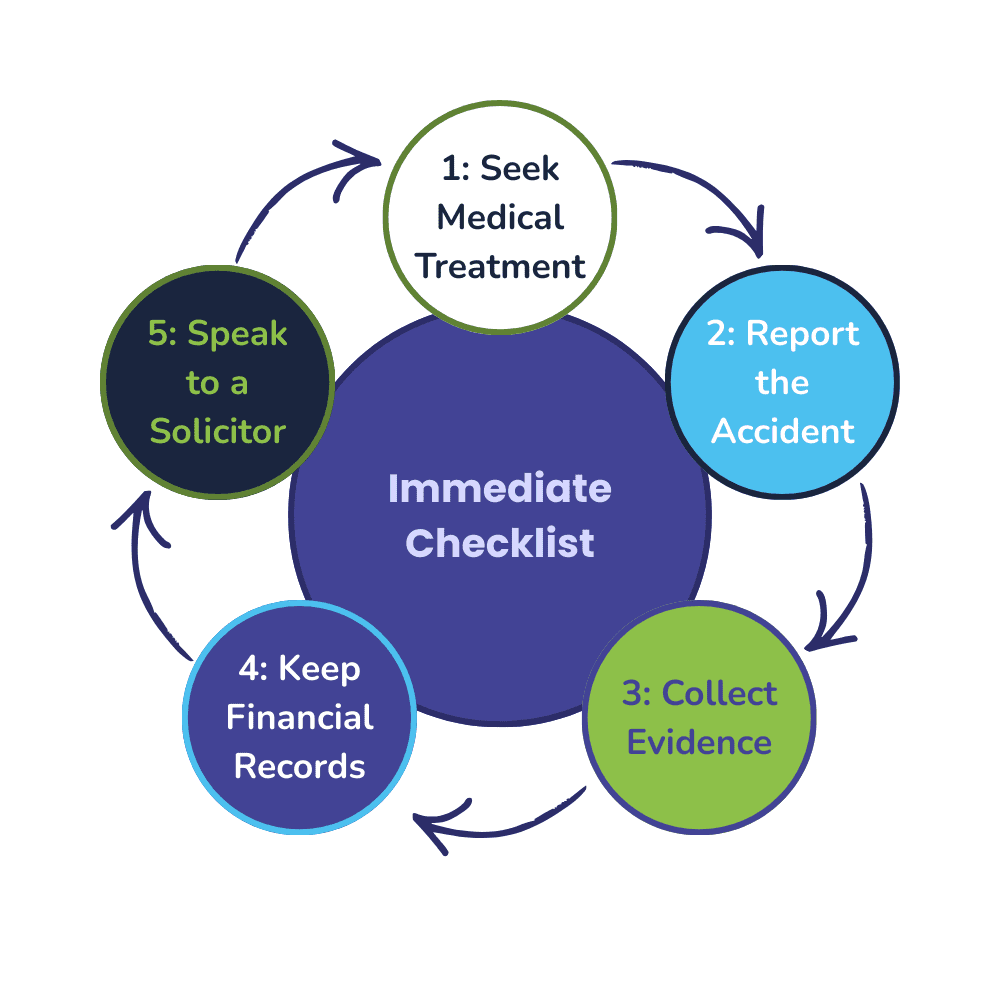
Immediate Checklist

1. Seek Medical Treatment

Even if the injury appears minor, symptoms can worsen over time – particularly with:

  • Back injuries
  • Neck injuries
  • Head injuries
  • Soft tissue damage
  • Repetitive strain injuries

You should:

  • Call 999 in an emergency
  • Attend A&E where appropriate
  • Visit your GP
  • Follow medical advice carefully

Medical records are crucial evidence. They create an independent record of:

  • The nature of your injury
  • When symptoms begin
  • The severity of the condition
  • Any ongoing impact

Delaying treatment can not only affect recovery but may also weaken your claim.

2. Report the Accident

Under UK law, workplace accidents must be properly recorded.

You should ensure the incident is entered into the company Accident Book. Check that the record includes:

  • The date and time
  • Where it happened
  • How it occurred
  • Details of your injuries
  • Names of any witnesses

Take a photograph of the entry for your own records.

If your employer refuses to record the accident, send a written email describing what happened. This creates a documented timeline.

Failure to report the accident promptly is one of the most common reasons insurers dispute claims.

3. Collect Evidence

If you are physically able, gather evidence as soon as possible.

This may include:

  • Photographs of the accident scene
  • Images of defective equipment
  • Pictures of spillages or hazards
  • Contact details of witnesses
  • Copies of emails or reports
  • Preserving damaged clothing or PPE

If CCTV footage may exist, request that it is preserved immediately. Many systems automatically delete footage within days or weeks.

The earlier evidence is secured, the stronger your position will be.

4. Keep Financial Records

If your injury results in financial loss, you may be entitled to recover those losses as part of your compensation claim. You can read more about potential claim values in our guide on accident at work claims and how much compensation you could get.

Keep evidence of:

  • Loss of earnings
  • Reduced overtime
  • Missed bonuses
  • Travel costs
  • Prescription changes
  • Rehabilitation or private treatment
  • Care provided by family members

These losses form part of what is known as special damages and can significantly increase the overall value of your claim.

5. Speak to a Specialist Solicitor

Many people delay seeking legal advice because they:

  • Feel loyal to their employer
  • Worry about job security
  • Assume they were partly at fault
  • Think the process will be stressful

In reality, most accident at work claims are handled by the employer’s insurer and proceed professionally.

Early legal advice ensures:

  • Evidence is preserved
  • Deadlines are protected
  • Liability is investigated properly
  • Your claim is accurately valued
  • You are not pressured into early settlement

A solicitor can also explain how a No Win No Fee agreement works, so you understand the financial position from the outset.

Immediate checklist

Mistakes to Avoid

Certain common mistakes can weaken or even prevent a successful claim.

Failing to Report the Accident

If an accident is not recorded, insurers may argue it did not happen as described.

Delaying Medical Treatment

A gap between the accident and treatment may raise questions about causation.

Accepting Early Low Offers

Insurers sometimes make early offers before full medical evidence is available.

Once accepted, you cannot usually reopen the claim – even if your condition worsens.

Posting on Social Media

Social media posts can be used by insurers to challenge claims.

Avoid posting about:

  • Your accident
  • Your injuries
  • Your activities during recovery

Missing the 3-Year Time Limit

Most accident claims must be issued within three years. You can read more about the relevant deadlines in our guide on accident at work time limits and how long you have to claim.

Even though that may seem like a long time, delaying can seriously weaken your case as:

  • Evidence fades
  • CCTV is deleted
  • Witnesses leave employment
  • Documentation is lost

Early action protects your position.

Why Specialist Advice Matters

Understanding your rights is the first step. Enforcing them effectively is the next.

Workplace accident claims often involve:

  • Disputes over liability
  • Arguments about risk assessments
  • Insurer negotiations
  • Complex medical evidence

A specialist solicitor can assess whether your employer has breached statutory duties and whether that breach caused your injury.

Why Choose NJS Law for Your Accident at Work Claim?

When you are injured at work, you need more than general advice — you need clear, strategic legal guidance from solicitors who understand employer liability, workplace regulations and insurer tactics.

At NJS Law, we act exclusively in the interests of injured individuals. We understand the physical, financial and emotional pressure that follows a workplace accident. Our role is to remove that pressure and handle the legal process with clarity and confidence. You can read what clients say about our service on our NJS Law reviews.

When you instruct NJS Law, you can expect:

We are experienced in handling claims involving:

  • Manual handling injuries
  • Slips, trips and falls
  • Construction site accidents
  • Machinery and equipment failures
  • Industrial and factory injuries 
  • Workplace head and back injuries

Every case is handled with attention to detail and a focus on achieving the best possible outcome for you.

Speak To NJS Law Today

If you have suffered an accident at work, early advice can make a significant difference to your claim.

Contact our Accident at Work Solicitors  today for a confidential discussion about your situation. We will explain:

There is no obligation to proceed – just clear professional advice.

Call us today or complete our online enquiry form to speak with a specialist accident at work solicitor.

Your recovery matters. Your rights matter.

Let NJS Law help you secure the compensation you deserve.

→ Learn more About Us

We’re Here To Help

Frequently Asked Questions

Can I claim if the accident was partly my fault?

Yes. Even if you were partly responsible, you may still receive compensation under contributory negligence principles.

Your compensation may be reduced to reflect your share of responsibility, but you are not automatically prevented from claiming. Employers still have a legal duty to provide a safe working environment.

What if the accident wasn't recorded in the Accident Book?

You can still bring a claim.

While accident book entries are helpful evidence, they are not essential. Medical records, witness statements, CCTV footage and photographs can all support your case.

It is advisable to notify your employer in writing as soon as possible if the incident was not formally recorded.

How long do I have to make an accident at work claim?

In most cases, you have three years from the date of the accident to start court proceedings.

If your injury developed over time (for example, repetitive strain injury), the three year period may begin from the date you became aware that your condition was work-related.

There are exceptions for children and individuals lacking mental capacity.

Can my employer dismiss me for making a claim?

No. It is unlawful for an employer to dismiss or treat you unfairly for pursuing a legitimate personal injury claim. You can read more about your rights in our guide on being sacked for making an accident at work claim.

If your employer takes adverse action against you because you exercised your legal rights, this may amount to unfair dismissal or victimisation.

Will claiming compensation affect my job?

Most workplace accident claims are handled by the employer’ liability insurance.

The claim is made against the insurer – not directly against your employer personally. Professional employers understand that insurance exists for this purpose.

CONTACT US

Get in touch using the form below or via the following methods:

Ask NJS

For fast, friendly affordable legal advice. Contact a member of our team today.

FAQ

For any questions we may be able to answer, discover our FAQ section.

Categories
Accident at Work

Workplace Accident Legal Rights UK

Accident at Work Time Limits: How Long Do I Have to Claim?

JackScott

If you have been injured at work, it is important to understand that you are not simply relying on goodwill or company policy — you are protected by law.

Many employees are unaware of the full extent of their legal rights following a workplace accident. Some assume accidents are “just part of the job.” Others feel reluctant to question their employer’s safety standards.

However, UK health and safety legislation places clear and enforceable duties on employers. When those duties are breached and an employee is injured as a result, the law provides a route to compensation.

Understanding your workplace accident legal rights in the UK can help you:

  • Recognise when safety standards have fallen short
  • Protect yourself from further harm
  • Hold employers accountable
  • Secure financial compensation where appropriate

This guide explains the core legal protections that apply to employees and workers across England and Wales.

Your Rights Under UK Law

Under the Health and Safety etc Act 1974 and related regulations, employers have a duty to take reasonable steps to ensure the health, safety and welfare of their employees.

You have the legal right to:

  • A safe working environment
  • Proper training for the tasks you are required to perform
  • Safe and properly maintained equipment
  • Suitable personal protective equipment (PPE) where necessary
  • Adequate risk assessments
  • Systems of work designed to minimise foreseeable risks
  • Raise safety concerns without fear of rehabilitation

Employers must not simply react to accidents – they must take proactive steps to prevent them.

This includes:

  • Carrying out regular safety inspections
  • Implementing clear health and safety policies
  • Providing supervision where required
  • Maintaining machinery in safe working order
  • Responding appropriately to reported hazards

If these duties are breached and you are injured, you may have grounds for a personal injury claim.

Why Legal Advice Matters

Understanding your rights is the first step. Enforcing them effectively is the next.

Workplace accident claims often involve:

  • Disputes over liability
  • Arguments about risk assessments
  • Insurer negotiations
  • Complex medical evidence

A specialist solicitor can assess whether your employer has breached statutory duties and whether that breach caused your injury.

Why Choose NJS Law for Your Accident at Work Claim?

When you are injured at work, you need more than general advice — you need clear, strategic legal guidance from solicitors who understand employer liability, workplace regulations and insurer tactics.

At NJS Law, we act exclusively in the interests of injured individuals. We understand the physical, financial and emotional pressure that follows a workplace accident. Our role is to remove that pressure and handle the legal process with clarity and confidence. You can read what clients say about our service on our NJS Law reviews.

When you instruct NJS Law, you can expect:

We are experienced in handling claims involving:

  • Manual handling injuries
  • Slips, trips and falls
  • Construction site accidents
  • Machinery and equipment failures
  • Industrial and factory injuries 
  • Workplace head and back injuries

Every case is handled with attention to detail and a focus on achieving the best possible outcome for you.

Speak To NJS Law Today

If you have suffered an accident at work, early advice can make a significant difference to your claim.

Contact our Accident at Work Solicitors  today for a confidential discussion about your situation. We will explain:

There is no obligation to proceed – just clear professional advice.

Call us today or complete our online enquiry form to speak with a specialist accident at work solicitor.

Your recovery matters. Your rights matter.

Let NJS Law help you secure the compensation you deserve.

→ Learn more About Us

We’re Here To Help

Frequently Asked Questions

Can I claim if the accident was partly my fault?

Yes. Even if you were partly responsible, you may still receive compensation under contributory negligence principles.

Your compensation may be reduced to reflect your share of responsibility, but you are not automatically prevented from claiming. Employers still have a legal duty to provide a safe working environment.

What if the accident wasn't recorded in the Accident Book?

You can still bring a claim.

While accident book entries are helpful evidence, they are not essential. Medical records, witness statements, CCTV footage and photographs can all support your case.

It is advisable to notify your employer in writing as soon as possible if the incident was not formally recorded.

How long do I have to make an accident at work claim?

In most cases, you have three years from the date of the accident to start court proceedings. You can read a detailed guide on accident at work time limits and how long you have to claim.

If your injury developed over time (for example, repetitive strain injury), the three year period may begin from the date you became aware that your condition was work-related.

There are exceptions for children and individuals lacking mental capacity.

Can my employer dismiss me for making a claim?

No. It is unlawful for an employer to dismiss or treat you unfairly for pursuing a legitimate personal injury claim. You can read more about your rights in our guide on being sacked for making an accident at work claim.

If your employer takes adverse action against you because you exercised your legal rights, this may amount to unfair dismissal or victimisation.

Will claiming compensation affect my job?

Most workplace accident claims are handled by the employer’ liability insurance.

The claim is made against the insurer – not directly against your employer personally. Professional employers understand that insurance exists for this purpose.

CONTACT US

Get in touch using the form below or via the following methods:
Ask NJS

For fast, friendly affordable legal advice. Contact a member of our team today.

FAQ

For any questions we may be able to answer, discover our FAQ section.