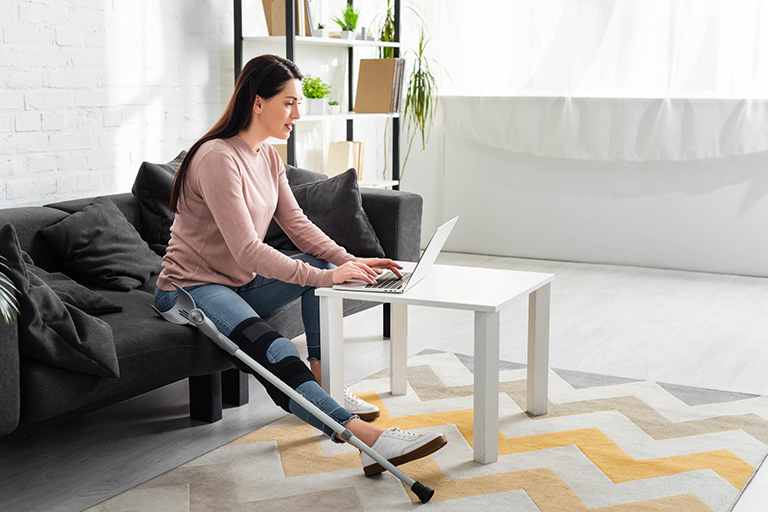

Slips, trips, and falls on the same level are the most common type of workplace accident in England and Wales, accounting for a significant proportion of all non-fatal injuries reported to the HSE each year. Yet many of them are entirely preventable. Employers are required by law to maintain safe floors, walkways, and working areas — and when they fail, and you are injured as a result, you are entitled to claim compensation.
NJS Law’s specialist team handles workplace slip, trip, and fall claims across England and Wales on a No Win, No Fee basis. This page is part of our Accident at Work Claims service.
There are no upfront costs, no hidden fees, and no financial risk to you. If we do not win your case, you pay nothing.
Trustpilot
Combined Legal Experience
Single Settlement Secured
Regulated - No. 8006550
Personal Injury Panel accreditation
Slips and trips are the most common workplace accident — and most are preventable.
If your employer failed to maintain a safe environment, NJS Law will help you claim.
Discover today if you’re eligible to make a claim.
Complete the form below, email or call our slip and trip claims solicitors for free, no-obligation advice.
A workplace slip, trip, or fall claim is a legal claim for compensation against your employer — or the occupier of the premises where you were working — when a failure to maintain safe floors, walkways, or working areas causes you to slip, trip, or fall and suffer injury.
This type of claim is distinct from a fall from height claim: it covers falls on the same level — ground-level accidents caused by floor conditions, obstructions, or poor environmental conditions.
Common causes of workplace slips, trips, and falls:
The claim is made against your employer’s or the occupier’s liability insurance. You are not claiming directly from anyone’s personal funds.
Places a general duty on employers to ensure, so far as is reasonably practicable, the health, safety, and welfare of all employees — including the maintenance of a safe place of work and safe means of access and egress.
Requires employers to carry out suitable and sufficient risk assessments of all workplace hazards — including floor conditions, spillage risks, and pedestrian routes. Failure to identify and address a foreseeable slip or trip risk is a breach of these Regulations.
Places a general duty on employers to ensure, so far as is reasonably practicable, the health, safety, and welfare of all employees — including the maintenance of a safe place of work and safe means of access and egress.
Where the claimant is a visitor to premises (rather than an employee), the occupier owes a common duty of care to ensure the premises are reasonably safe. This is relevant for contractors, visitors, and self-employed workers who are not the direct employee of the occupier.
You may be able to make a slip, trip, or fall claim if you are:
You may still be entitled to claim even if you were partly responsible — for example, if you were distracted, running, or wearing inappropriate footwear. Where both you and your employer share responsibility, your compensation is reduced proportionally under the Law Reform (Contributory Negligence) Act 1945, but you do not lose the right to claim altogether. See: Can I Claim If the Accident Was Partly My Fault?
Solicitors use the Judicial College Guidelines, 18th edition (April 2026) to estimate the value of your injury. Common injuries from workplace slips, trips, and falls include:
Injury Type | Severity | Approximate Range |
Wrist fracture (reaching out to break fall) | Minor to moderate | £3,530 – £29,260 |
Elbow injury | Minor to severe | £4,350 – £54,830+ |
Shoulder injury (rotator cuff / dislocation) | Moderate to serious | £4,150 – £48,030 |
Knee injury (ligament damage / fracture) | Moderate to serious | £14,840 – £26,190 |
Ankle fracture | Moderate to severe | £13,740 – £69,700 |
Hip fracture | Moderate to serious | £11,820 – £36,770 |
Back injury (disc damage / soft tissue) | Minor to moderate | £2,300 – £38,780 |
Head / brain injury (from striking ground) | Minor to severe | £2,690 – £379,100+ |
Facial injuries (striking floor or fixture) | Moderate to severe | £3,950 – £30,090+ |
You can also claim all financial losses caused by the accident: lost earnings (time off work taken and future loss if the injury affects your ability to work), medical treatment costs, physiotherapy and rehabilitation, care costs provided by family, and travel to medical appointments. See: General Damages vs Special Damages and Average Compensation Payouts.
NJS Law has recovered over £6 million for injured workers in 2024–25 alone.
Report the accident to your employer as soon as possible and ensure it is recorded in the workplace accident book. Ask for a copy of the entry. This creates an official record of the incident date, location, and circumstances.
Visit your GP or A&E immediately after the accident — even if injuries seem minor. Describe exactly how the accident happened. Medical records are one of the most important pieces of evidence in any workplace injury claim.
Photograph the accident scene, the hazard that caused the injury, and your injuries. Collect witness names and contact details. Request CCTV footage immediately — most employers overwrite recordings within 30 days.
Speak to one of our specialist accident at work solicitors for a free, no-obligation assessment of your claim. We will tell you clearly whether you have a valid claim and what it is likely to be worth.
If we take on your case, we gather all available evidence and issue a formal Letter of Claim to your employer’s insurer. They have 21 days to acknowledge receipt and a further period to investigate and respond.
You will be referred to an independent medical expert who will examine you and produce a report on your injuries, prognosis, and any ongoing treatment you need. This report is central to valuing your claim.
We present a full Schedule of Loss to the defendant’s insurer and negotiate the best possible settlement on your behalf. Around 95% of claims settle at this stage — without going to court.
Once a settlement is agreed or judgment awarded, your compensation is paid. Your solicitor’s success fee is deducted at this stage — the amount is agreed with you before you sign anything.
Under the Limitation Act 1980, there are strict time limits for bringing a personal injury claim. Act within these limits — missing the deadline is the most common reason valid claims cannot be pursued.
Claim Type | Time Limit | Notes |
Standard workplace accident | 3 years from date of accident | The most common scenario |
Industrial disease or occupational illness | 3 years from date of diagnosis (or “date of knowledge”) | Applies where symptoms developed gradually over time |
Child injured at work (or as a visitor) | 3 years from their 18th birthday | A parent or guardian can bring a claim at any time before the child turns 18 |
Person lacking mental capacity | Time limit suspended during period of incapacity | A litigation friend manages the claim |
Fatal workplace accident | 3 years from date of death | Dependants may claim under the Fatal Accidents Act 1976 |
For a full explanation of all time limit exceptions and what to do if you are approaching your deadline, see our guide: Personal Injury Claim Time Limits in England and Wales.
For guidance on how long the claim process itself takes once you have started: How Long Does a Personal Injury Claim Take?
Case highlight
Our client arrived for work early one morning when his forklift truck struck a pothole hidden under murky water at the loading bay. The impact caused severe spinal injuries, leaving him unable to move. What followed was four years of rehabilitation, specialist hospitals, and legal complexity — with NJS Law by his side throughout.
“Nichola, my solicitor, took on two professional barristers who got my claim going. Without NJS Law, I wouldn’t have gotten this far. They helped me far beyond things I wouldn’t have known about.”
— NJS Law client, £3.7 million settlement
Settlement
£3,700,000
Injury type
Severe spinal injury
Cause
Hidden pothole — employer negligence
Duration
4-year case
Interim payments
Yes — housing, mobility, therapy
Outcome
Full independence restored
Our client suffered serious leg injuries when faulty workplace equipment malfunctioned without warning, causing a heavy load to fall directly onto both legs.
The injuries included broken bones, severe ligament damage, an extended hospital stay, ongoing pain, and long-term mobility issues.
NJS Law successfully showed that the accident was caused by defective or poorly maintained equipment, and that the employer had failed to keep the workplace equipment safe and fit for purpose.
Our client suffered a broken leg after tripping over a wooden pallet that had been left in a cluttered and poorly maintained workspace while they were operating an electric pump truck.
As they tried to manoeuvre safely around colleagues, they fell backwards over the pallet, which had been left leaning against a pipe.
The pump truck then moved forward and trapped their leg.
NJS Law proved that the accident was caused by unsafe workplace conditions, poor housekeeping, and a failure to remove obvious hazards.
Our client was sent overseas for a work project and was repeatedly required to lift and carry heavy items without suitable lifting equipment, assistance, or adequate manual handling training.
The client suffered a serious back injury, required a four-day hospital stay, experienced long-term pain and mobility difficulties, and needed time off work to recover.
Although the accident happened abroad,
NJS Law successfully established that the UK-based employer had breached its duty of care.
Our client suffered a serious arm injury while trying to clear a printer jam at work.
The printer had been positioned tightly against a wall, making it difficult to access safely.
When the client tried to move it into a safer position, they felt sudden pain and heard three sharp snaps in their arm.
The injury caused muscle and soft-tissue damage, required medical treatment and rehabilitation, led to time off work, and resulted in ongoing pain, weakness, and reduced mobility.
NJS Law proved that the employer had failed to provide a safe workplace setup, proper risk assessments, and safe procedures for dealing with equipment faults.
All accident at work claims at NJS Law are handled under a Conditional Fee Agreement (CFA) — what most people call No Win, No Fee. Here is exactly what that means for you:
You can read a full plain-English explanation of how No Win, No Fee agreements work at No Win No Fee Claims Page.
Our dedicated solicitors specialise in slip and trip claims and have decades of combined experience securing fair compensation. We understand how stressful an accident can be and provide clear, supportive guidance throughout the process.
Contact us today for a free consultation and move forward with confidence under our No Win No Fee promise. Taking early legal advice can strengthen your claim and protect your rights.
680,000 workers were injured in the workplace in 2024–25. You may be entitled to compensation.
Being injured at work can feel overwhelming, especially if you’re unsure of your rights or worried about your job. Our expert solicitors provide clear, honest advice and manage every aspect of your claim, so you can focus on recovery while we fight for justice.
Our specialist EL/PL team brings decades of expertise across workplace injury, employer liability, and serious injury claims.
Authorised by the Solicitors Regulation Authority (no. 8006550).
Rated Excellent from 764 Trustpilot reviews and 4.7★ from 796 Google reviews. Top 10 UK Personal Injury Lawyers on Trustpilot.
£3.7M forklift settlement · £135,000 Manchester worker · £33,000 overseas injury · £18,000 arm injury. Real outcomes for real clients.
Making an accident at work claim can feel overwhelming. Below we’ve answered the most common questions our clients ask. These cover eligibility, time limits, compensation, and what happens if your case goes to court.
In most cases, you have three years from the date of your accident to issue court proceedings under the Limitation Act 1980. If your injury resulted from a gradually developing condition (such as an industrial disease), the three-year clock may run from when you first knew, or ought reasonably to have known, that the condition was linked to your work. For children, the three years starts on their 18th birthday. For full details, see our guide: Personal Injury Claim Time Limits
Compensation depends on the nature and severity of your injury, your recovery time, and the financial losses you have suffered. Minor injuries can attract a few thousand pounds. Serious or life-changing injuries can result in six or seven-figure awards. NJS Law will give you a realistic estimate at your free initial assessment. See the compensation table on this page for guidance on typical ranges by injury type.
The vast majority of accident at work claims — around 95% — settle before a court hearing. Court proceedings may be issued to protect the time limit or to accelerate negotiations, but in most cases a hearing is not required. If your case does go to trial, your solicitor will prepare you thoroughly for what to expect.
No. It is automatically unfair dismissal under the Employment Rights Act 1996 to dismiss an employee for asserting a statutory right, which includes the right to make a workplace injury claim. You also cannot legally be subject to detriment, demotion, or harassment for bringing a claim. Your employer’s liability insurer — not your employer personally — pays your compensation, which removes any financial incentive for your employer to treat you unfairly.
Yes, in many circumstances. If a site owner, principal contractor, or another employer had effective control over your working conditions, they may owe you a duty of care even if you were not their direct employee. Claims involving self-employed workers are more complex, but NJS Law handles them regularly. Contact us to discuss the specific circumstances of your accident.
The most useful evidence includes: the accident book entry, photographs of the hazard and your injuries, CCTV footage (request this immediately — most employers overwrite within 30 days), witness names and contact details, and your medical records from GP and hospital. Your solicitor will advise on any additional evidence needed once they have reviewed your case.
This is very common. An initial denial of liability does not mean your claim will fail. Your solicitor will investigate, gather evidence, and present a detailed legal case to the defendant’s insurer. If the insurer continues to dispute liability, court proceedings can be issued — which usually prompts a further round of negotiation. Most claims with strong evidence settle even after an initial denial.
You can still claim. The Employers’ Liability (Compulsory Insurance) Act 1969 requires all employers to hold liability insurance. The insurer remains liable even after the employer closes, goes into administration, or becomes insolvent. Your solicitor will trace the relevant insurer and pursue the claim directly against them. In some cases, insurers can be traced through the Employers’ Liability Tracing Office.
Yes. Where both you and your employer share responsibility for the accident, your compensation is reduced by the percentage of your fault under the Law Reform (Contributory Negligence) Act 1945. For example, if you are found 25% responsible and your injuries are valued at £40,000, you would recover £30,000. Contributory negligence reduces your award — it does not bar you from claiming. For more, read: Can I Claim If the Accident Was Partly My Fault?
RIDDOR (Reporting of Injuries, Diseases and Dangerous Occurrences Regulations 2013) requires employers to report certain serious workplace accidents to the HSE. If your accident should have been reported under RIDDOR, a copy of that report can support your claim as an independent official record. If your employer failed to file a required report, this itself is evidence of poor health and safety compliance — and it will not prevent you from claiming. See the RIDDOR section on this page for more detail.
Yes — in some circumstances. If liability has been admitted and your losses are clear, your solicitor can apply to the court for an interim payment — a sum paid on account of your final compensation to help with immediate financial needs such as lost wages, medical costs, or care. This is particularly valuable in serious injury cases. For full details, read: Interim Payments in Personal Injury Claims
Our solicitors have written a library of plain-English guides to help you understand your rights. Read the articles most relevant to your situation:

Injured at work? Learn the key steps to take straight away to protect your health, evidence, and legal rights.

Find out how workplace injury compensation is calculated and what factors can affect the value of your claim.

Learn how No Win No Fee accident at work claims work and how you can start a claim without upfront legal fees.
A simple guide to the personal injury claims process, from starting your claim to reaching a settlement.

Understand your rights if you are worried about your job after making a workplace injury claim.

Learn what RIDDOR is, which workplace accidents must be reported, and how it may support your claim.

Find out your rights after a construction site accident and how to claim compensation for your injuries.

Learn how PUWER 1998 protects workers injured by unsafe machinery, tools, or workplace equipment.

Understand when you may be able to claim compensation after a fall from height at work.

Find out what affects the length of a personal injury claim and what to expect during the process.

Learn how PUWER 1998 protects workers injured by unsafe machinery, tools, or workplace equipment.

Learn how personal injury payouts are assessed and why compensation varies from case to case.

Understand the key time limits for making a personal injury claim in England and Wales.

Find out how partial fault can affect your personal injury claim and compensation amount.

Learn the difference between compensation for pain and suffering and compensation for financial losses.

Find out when interim payments may be available before your personal injury claim fully settles.
For fast, friendly affordable legal advice. Contact a member of our team today.