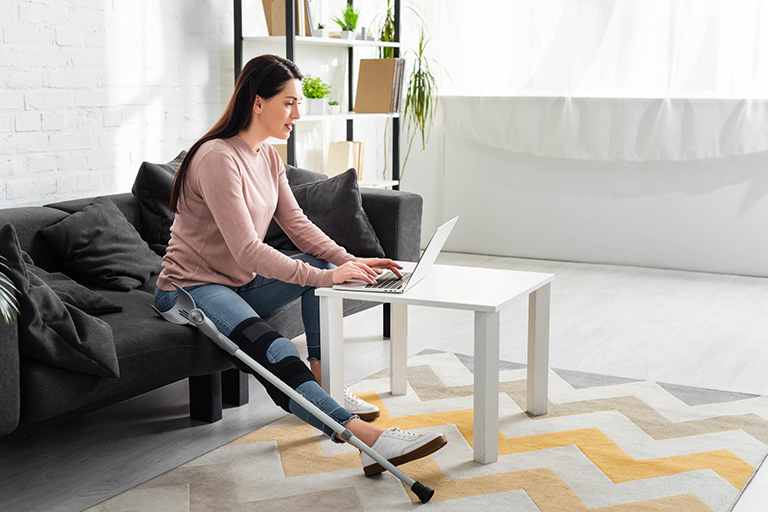

If you have been injured on premises controlled by someone else – a shop, a restaurant, a car park, a public building, or private land – you may be entitled to make an occupiers’ liability claim for compensation. The person or organisation in control of those premises has a legal duty under the Occupiers’ Liability Act 1957 to take reasonable care to keep lawful visitors safe. If they failed in that duty and you were injured as a result, the law provides a route to redress.
NJS Law is a specialist personal injury firm handling occupiers’ liability claims on a no win, no fee basis. We act for injured people, never for insurers or defendants. Our solicitors assess every case honestly and will tell you clearly whether you have a viable claim – at no cost and with no obligation to proceed.
Trustpilot
Combined Legal Experience
Free Initial Consultation
Regulated & PI Panel Accredited
Handling claims across England and Wales
Discover today if you’re eligible to make a claim.
Complete the form below, email or call our occupier liability solicitors for free, no-obligation advice.
Occupiers’ liability is the branch of personal injury law that governs the duty of care owed by the person or organisation in control of premises to those who enter them. Under the Occupiers’ Liability Act 1957, an occupier must take reasonable steps to ensure that lawful visitors – people who have permission to be on the premises – are kept reasonably safe whilst there. Read more about occupiers’ liability in the UK
The word “occupier” does not simply mean the owner of a property. It means whoever has control of the premises – which may be a business, a landlord, a local council, a management company, or any other individual or organisation responsible for the condition of that space.
In certain circumstances, a duty of care also extends to people who enter land without permission. The Occupiers’ Liability Act 1984 sets out the more limited duty owed to trespassers and other non-visitors in specific situations.
You may be eligible to make an occupier liability claim if:
What if I was partly at fault? Being partly responsible for the accident does not automatically prevent you from claiming. The court can apportion responsibility between you and the occupier – this is called contributory negligence – and your compensation may be reduced proportionately, rather than extinguished entirely.
If you are unsure whether your situation qualifies, our team can give you a free, no-obligation assessment. We will tell you honestly what we think, with no pressure to proceed. See our guide: Can I Claim If the Accident Was Partly My Fault?
In most cases, you have three years from the date of your accident to start legal proceedings for an occupiers’ liability claim. This time limit is set by the Limitation Act 1980. If proceedings are not issued within this period, your claim will ordinarily be statute-barred – meaning you will lose the right to pursue it, regardless of its merits.
There are, however, important exceptions to the standard three-year rule:
Even within the three-year window, the sooner you take legal advice the better. Evidence – CCTV footage, accident book records, witness recollections – becomes harder to obtain as time passes.
For a full explanation of all time limit exceptions and what to do if you are approaching your deadline, see our guide: Personal Injury Claim Time Limits in England and Wales.
There is no fixed sum. Compensation in occupiers’ liability claims is calculated individually, based on the nature and severity of your injuries and the financial losses you have sustained. It comprises two main categories:
General damages compensate for the pain, suffering and loss of amenity caused by your injuries. Courts and practitioners assess these by reference to the Judicial College Guidelines (current edition), which provide indicative ranges for different injury types and severities. The table below gives illustrative ranges for injuries commonly arising in occupiers’ liability accidents – these are general damages only and are not guarantees of what any individual claim will achieve.
Injury Type |
Severity | Indicative General Damages Range |
Soft tissue injuries (e.g. sprains, strains) | Minor – full recovery within 2 years |
£1,500 – £7,500 |
Soft tissue injuries | Moderate – ongoing symptoms | £7,500 – £20,000 |
Wrist fracture | Moderate – good recovery | £10,000 – £24,000 |
Ankle injury | Moderate – some ongoing symptoms |
£12,500 – £26,000 |
Knee injury | Moderate – ongoing discomfort or instability |
£14,000 – £27,000 |
Back injury | Minor to moderate | £2,300 -£27,000 |
Shoulder injury | Moderate | £7,500 -£18,500 |
Hip/pelvis fracture | Moderate | £24,000 – £36,000 |
These figures are illustrative ranges taken from the Judicial College Guidelines and are provided as a general reference only. The compensation you may receive depends on the specific facts of your case, including the severity of your injuries, your recovery, and any lasting impact. These figures should not be treated as an indication of the outcome in your claim.
Special damages compensate for financial losses you have actually incurred or will incur as a result of your injuries. These may include:
Our occupiers’ liability solicitors handle claims arising from a wide range of premises and circumstances across England and Wales.
Slipping on a wet floor without adequate warning, tripping over a misplaced display, or falling on uneven surfaces in a retail environment are among the most common occupiers’ liability claims. Retailers have a duty to inspect their premises regularly and to address hazards promptly.
Shopping centres and retail parks involve multiple occupiers – the centre management, individual retailers, and contractors – and determining which party is responsible for maintaining the specific area where you were injured is a key part of building your claim.
Spills on floors, broken seating, inadequate lighting in access areas, and poorly maintained outdoor spaces can all give rise to occupiers’ liability claims against food and drink premises. The occupier’s duty applies to the full extent of the premises they control, including car parks and external areas.
Local authorities, government departments, and public bodies that control buildings such as leisure centres, libraries, council offices, and public car parks owe the same duty of care as private occupiers under the Occupiers’ Liability Act 1957.
Where a tenant or visitor is injured due to a defect in a rented property – a broken staircase, defective flooring, or a poorly maintained common area – the landlord or managing agent who controls that part of the premises may be liable for resulting injuries.
Potholes, uneven surfaces, inadequate lighting, and poorly maintained walkways in car parks and external areas controlled by businesses or councils are a common cause of occupiers’ liability injuries. The duty of care applies to external as well as internal areas.
Gyms, sports centres, swimming pools, concert venues and stadiums all owe a duty of care to their visitors. Where inadequate maintenance, poorly designed facilities, or failure to warn of known hazards results in injury, an occupiers’ liability claim may arise.
Several pieces of legislation impose duties on occupiers to keep visitors reasonably safe while on their premises. A breach of any of these laws can form the basis of an occupiers’ liability claim:
The primary legislation governing occupiers' liability claims. It requires occupiers to take reasonable care to ensure that lawful visitors are reasonably safe while using the premises for the purposes for which they are invited or permitted to be there. This applies to businesses, shops, restaurants, hotels, landlords, local authorities, and anyone exercising sufficient control over premises.
The foundational case establishing the "neighbour principle" and the general duty of care in English law. The basis of all negligence claims.
Making an occupiers’ liability claim with NJS Law follows five clear stages. We handle the legal work -you focus on your recovery.
Call us or complete our online form. One of our specialist solicitors will review the circumstances of your accident, ask you about your injuries, and give you an honest assessment of whether you have a viable claim – at no cost and with no obligation to proceed.
If we consider your claim has good prospects, we will enter into a Conditional Fee Agreement (no win, no fee) with you. You will owe us nothing in legal fees if the claim does not succeed. We will explain the terms clearly before you sign anything.
Our team will help you obtain and preserve the evidence needed to support your claim – including photographs of the accident scene, accident book records from the premises, CCTV footage (where available and before it is overwritten), witness statements, and medical records documenting your injuries. The sooner you instruct us, the easier it is to secure this evidence.
We notify the defendant occupier (or their insurer) of your claim and begin formal negotiations. Many occupiers’ liability claims settle at this stage without the need for court proceedings. We will keep you informed throughout and will not recommend any settlement we do not consider fair.
If a fair settlement is agreed, your compensation is paid. If the defendant disputes liability or the offer is inadequate, we will advise you on the merits of issuing court proceedings and represent you through that process. The overwhelming majority of our claims resolve without a final court hearing.
Straightforward claims often resolve within 3-9 months. More complex or disputed cases may take 12-24 months. We will give you a realistic timeframe at the outset based on the specific facts of your case.
For a full walkthrough of the process: Occupier Liability Claim Guide
If you were injured through no fault of your own, you may be entitled to claim compensation.
Our solicitors offer free initial advice to confirm your eligibility and guide you on the next steps.
All accident at work claims at NJS Law are handled under a Conditional Fee Agreement (CFA) — what most people call No Win, No Fee. Here is exactly what that means for you:
You can read a full plain-English explanation of how No Win, No Fee agreements work at No Win No Fee Claims Page.
Our occupier liability solicitors combine decades of experience with a client-first approach. We understand how challenging it can be to deal with an injury caused by unsafe premises — and we’ll stand by your side throughout the entire claims process.
Contact us today for a free consultation and take the first step toward securing the compensation and support you deserve.
There are many personal injury solicitors to choose from across England and Wales. Here is why our clients choose – and stay with – NJS Law.
We never represent insurers, employers or defendants. Every case we take on, we take on because we believe the injured person deserves fair compensation.
Our no win, no fee model means you face no financial risk. Before anything is signed, we explain exactly how our fee is structured and what the deduction from your compensation will be. There are no surprises.
We explain every step in clear, non-technical language, so you always know where you stand.
Our personal injury team has handled thousands of cases across every claim type – from minor road accident injuries to multi-million pound serious injury settlements.
We hold a 4.8-star rating on Trustpilot from 765 verified reviews, and 4.7 stars on Google from 796 reviews. We are proud to be listed among the Top 10 UK Personal Injury Lawyers on Trustpilot.
We are regulated by the Solicitors Regulation Authority (SRA No. 8006550), accredited by the Law Society and hold PI Panel accreditation – independent quality marks that confirm our personal injury expertise.
Starting a personal injury claim can feel daunting, and you’re likely to have questions about how the process works, what it costs, and how long it takes. To help, we’ve answered the most common questions our clients ask — from evidence to compensation amounts and court proceedings.
A personal injury claim is a legal process that allows you to seek financial compensation when you have been physically or psychologically injured because of someone else’s negligence or wrongdoing. In England and Wales, if another person, business, or organisation failed in their duty of care towards you — and that failure caused your injury — you have the right to claim compensation. This principle has been the foundation of personal injury law since Donoghue v Stevenson [1932].
Anyone who has been injured on premises controlled by another person or organisation may be able to make a claim, provided they were a lawful visitor at the time and the occupier failed to keep the premises reasonably safe. In limited circumstances, people who were not lawful visitors may also have a claim under the Occupiers’ Liability Act 1984. Children, individuals who lack mental capacity, and dependants of people who have died as a result of occupiers’ liability injuries all have specific legal provisions that apply to them.
Compensation depends on the nature and severity of your injuries and your financial losses – there is no fixed sum. General damages are assessed by reference to the Judicial College Guidelines; special damages cover your actual financial losses including medical costs, rehabilitation, lost earnings and travel. See the compensation section above for indicative ranges. We can give you a more specific assessment once we understand the facts of your case.
. Read: What is the Average Personal Injury Compensation Payout in the UK?
In most cases, three years from the date of the accident under the Limitation Act 1980. Exceptions apply: for children, the period runs from their 18th birthday (claim possible until age 21); for persons lacking mental capacity, the period does not run while that incapacity continues; and where injuries are not immediately apparent, the period may run from the date of knowledge rather than the accident date. Act promptly, evidence is easier to obtain closer to the event.
You need to establish four things: (1) the defendant controlled the premises; (2) you were a lawful visitor, or the OLA 1984 duty applied; (3) the premises were not reasonably safe, or the occupier failed to address a foreseeable risk; and (4) the unsafe condition caused your injury. We will assess all four elements when you contact us.
Gather, as soon as possible: photographs or video of the exact accident location; names and contact details of any witnesses; the name of the premises and, if possible, a member of staff you spoke to; a copy of any accident book report; and medical records documenting your injuries. Contact us before requesting CCTV footage – there is a specific process for preserving this evidence before it is overwritten long-term support — is fully recognised and valued in your claim.
Yes, in many cases. Partial responsibility does not automatically bar a claim. The court can apportion fault between you and the occupier – contributory negligence – and any reduction to your compensation reflects your share of responsibility. Even if you believe you contributed to the accident, it is worth taking advice to understand whether the occupier also bears responsibility.
The 1957 Act governs the duty owed to lawful visitors – people who have express or implied permission to be on the premises. The 1984 Act governs the more limited duty owed to people who do not have that permission, including trespassers, in specific circumstances where the occupier is aware of a danger and the risk of a non-visitor being present is reasonably foreseeable. Most occupiers’ liability claims arise under the 1957 Act
Straightforward claims where liability is not disputed typically resolve within 3-9 months. Claims where the occupier disputes responsibility or injuries are more complex may take 12-24 months. Claims that proceed to a full court hearing can take longer. We will give you a realistic estimate based on the facts of your case at the outset.
. Read our full guide: How Long Does a Personal Injury Claim Take in England and Wales?
The majority of occupiers’ liability claims settle without a final court hearing. If the defendant disputes liability and negotiations do not produce a fair offer, it may be necessary to issue court proceedings – but many claims settle after proceedings are issued and before a hearing takes place. We will advise you at every stage on whether any offer made is reasonable and on the prospects of achieving a better outcome at trial.
Free consultation · No win, no fee · SRA regulated · 4.8★ on Trustpilot
Stay informed with practical advice and in-depth guides on occupier liability injury claims. From understanding liability for slips, trips, and falls to learning how compensation is calculated, our resources are designed to give you clarity and confidence.
Browse the latest articles to see how real cases are handled, what factors affect compensation, and how our solicitors approach occupier liability claims. These insights can help you understand your rights and what to expect when making a claim.
For fast, friendly affordable legal advice. Contact a member of our team today.