

When accidents occur on land where someone did not have permission to be — such as abandoned buildings, construction sites or private land — liability is not automatically excluded.
The Occupiers’ Liability Act 1984 governs the duty owed by occupiers of premises to non-visitors, including trespassers.
Although the duty under the 1984 Act is more limited than the duty owed to lawful visitors under the Occupiers’ Liability Act 1957, it does not mean occupiers owe no responsibility at all.
In certain circumstances, an occupier can still be legally liable if a trespasser or other non-visitor suffers injury due to a dangerous condition on the land.
The Act strikes a balance between:
Understanding when the 1984 Act applies is essential if an injury occurred in circumstances involving trespass or unauthorised entry.
The Occupiers’ Liability Act 1984 sets out when a duty of care may arise towards individuals who are not lawful visitors.
Unlike the 1957 Act, which imposes a general “common duty of care” to visitors, the 1984 Act only imposes a duty in specific circumstances involving known and foreseeable dangers.
It applies where:
This most commonly arises in cases involving:
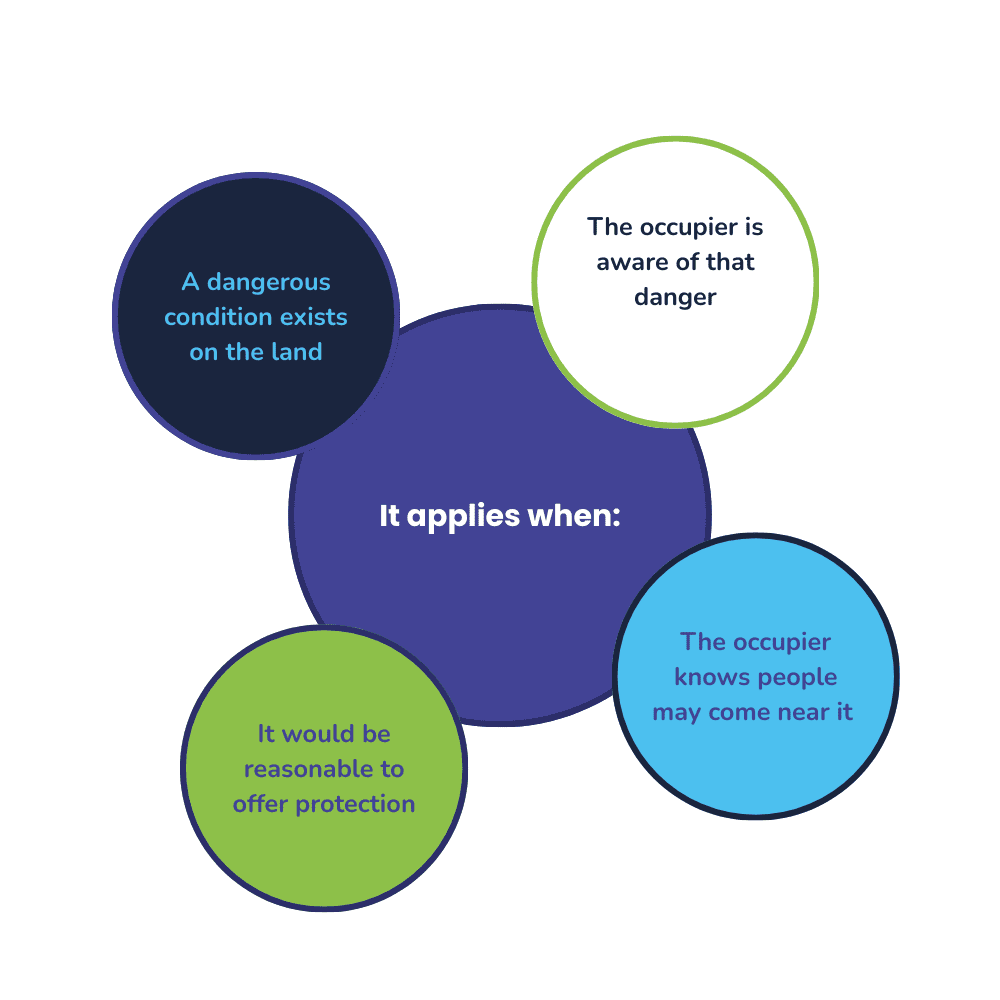
Under Section 1 of the Act, a duty is owed only if three conditions are satisfied:
All three elements must be present.
If they are, the occupier owes a duty to take reasonable care to prevent injury from the identified danger.
The duty under the 1984 Act is narrower than under the 1957 Act.
Occupiers are not required to make premises fully safe for trespassers. However, they may need to take reasonable steps such as:
The law balances personal responsibility with the occupier’s knowledge of foreseeable risk.
Claims under the 1984 Act commonly arise in cases involving:
A recurring issue is children entering unsecured premises. The courts recognise that children may not appreciate certain risks in the same way adults do.
Foreseeability is central to claims under the 1984 Act.
An occupier is not automatically liable simply because someone trespassed and was injured.
The court will consider:
For example, if children regularly enter an abandoned site through a broken fence and the occupier is aware of this, failing to repair the fence or secure dangerous features may amount to a breach.
The 1984 Act recognises that some dangers are obvious.
Courts may find that an occupier is not liable where:
Personal responsibility plays a greater role under the 1984 Act than under the 1957 Act.
While both Acts concern premises liability, there are important differences:
1957 Act | 1984 Act |
Applies to lawful visitors | Applies to trespassers and non-visitors |
Imposes a “common duty of care” | Imposes a limited duty in defined circumstances |
Focuses on making premises reasonably safe | Focuses on protection from known dangers |
Broader scope of protection | Narrower and more restrictive |
The 1984 Act does not create a general obligation to make land safe for all intruders. It addresses specific, foreseeable dangers.
To succeed, a claimant must prove:
The Occupiers’ Liability Act 1984 reflects a balance between:
It ensures that occupiers cannot simply disregard hazardous conditions where they know people are likely to encounter them.

When you are injured on someone else’s property, you need clear advice from solicitors who understand premises liability law and insurer tactics.
At NJS Law, we act exclusively for injured individuals. We understand the physical, financial and emotional impact of unexpected accidents. You can read what clients say about our service on our NJS Law reviews.
When you instruct NJS Law, you can expect:
We handle claims involving:
Every case is handled with care and attention to detail.
If you have suffered an injury on someone else’s property, early advice can make a significant difference.
Contact our Occupier Liability Solicitors today for a confidential discussion about your situation. We will explain:
There is no obligation to proceed — just clear, professional advice.
Call us today or complete our online enquiry form to speak with a specialist occupier liability solicitor.
Your recovery matters. Your rights matter.
Let NJS Law help you secure the compensation you deserve.
→ Learn more About Us

Yes, but only in limited circumstances.
A trespasser must prove that the occupier knew of the danger, knew people might encounter it, and failed to take reasonable steps to prevent injury.
Claims are typically more difficult than those brought under the 1957 Act.
Yes.
Courts may take into account that children are less likely to appreciate risks.
If an occupier knows that children regularly access a dangerous area, they may be expected to take reasonable steps to secure it.
If a risk is obvious and the injured person voluntarily accepted it, the occupier may have a defence.
However, each case depends on the specific facts, including the age of the injured person and the nature of the hazard.
Not automatically.
Courts often consider whether the danger was a natural and obvious feature of the landscape.
Liability may arise if the occupier created or significantly increased the risk, or failed to act despite knowing of a specific foreseeable danger.
No.
The law does not require occupiers to eliminate all risks.
The question is whether reasonable steps were taken in light of foreseeable trespassing and the seriousness of the danger.
In most cases, the time limit is three years from the date of the accident (or date of knowledge).
Different rules apply to children and individuals lacking mental capacity.
Get in touch using the form below or via the following methods: