

Accidents in shops, restaurants, rental properties, offices and private homes are often legally assessed under one key piece of legislation: the Occupiers’ Liability Act 1957.
If you have been injured on someone else’s premises, this Act is likely to form the legal foundation of your claim.
The legislation establishes when a person or organisation that controls property can be held legally responsible for injuries suffered by visitors. It defines the standard of care required, the scope of that duty, and the circumstances in which liability may arise.
Understanding how the Act works is essential for determining:
Below, we explain the Occupiers’ Liability Act 1957 in clear, practical terms.
The Occupiers’ Liability Act 1957 is the primary legislation governing accidents involving lawful visitors to premises in England and Wales.
It sets out the legal duty owed by those who control premises to ensure that visitors are reasonably safe when using the property for the purpose for which they are invited or permitted to be there.
In practical terms, this Act forms the legal foundation of most slip, trip and fall claims arising in:
If an occupier fails to take reasonable care and someone is injured as a result, the Act provides the legal basis for bringing a compensation claim.

Section 2 of the Act imposes what is known as the “common duty of care.”
This requires occupiers to take reasonable care to ensure visitors are reasonably safe in using the premises for the purposes for which they are invited or permitted to be there.
This includes:
The duty relates not just to the physical condition of the premises but also to activities carried out there.
The law does not require occupiers to eliminate all risks. Instead, the standard is reasonableness.
Courts consider factors such as:
For example:
Failing to carry out basic safety checks, inspections or maintenance may amount to a breach of duty.
Children
Occupiers must be prepared for children to be less careful than adults. The premises should be reasonably safe for a child of that age.
For example, features that might be safe for adults could present foreseeable risks to children.
Skilled Visitors
The Act recognises that certain visitors — such as tradespeople — may be expected to guard against risks ordinarily associated with their profession.
For example, an electrician may be expected to understand basic electrical risks.
However, this does not remove the occupier’s duty entirely.
Independent Contractors
If damage is caused by faulty work carried out by an independent contractor, the occupier may avoid liability only if it was reasonable to:
Simply hiring a contractor does not automatically remove responsibility.
Examples of situations that may amount to a breach include:
Each case depends on the specific facts and whether the occupier took reasonable steps.
It is not enough to show that a hazard existed. A claimant must prove that:
For example, if a spillage occurred seconds before a fall, and no reasonable inspection system could have prevented it, liability may not arise.
The timing and foreseeability of the hazard are often central to disputes.
Occupiers may defend claims by arguing:
In some cases, compensation may be reduced for contributory negligence if the injured person was partly responsible.
The Occupiers’ Liability Act 1957 plays a vital role in promoting safety standards across public and private premises.
It ensures that:
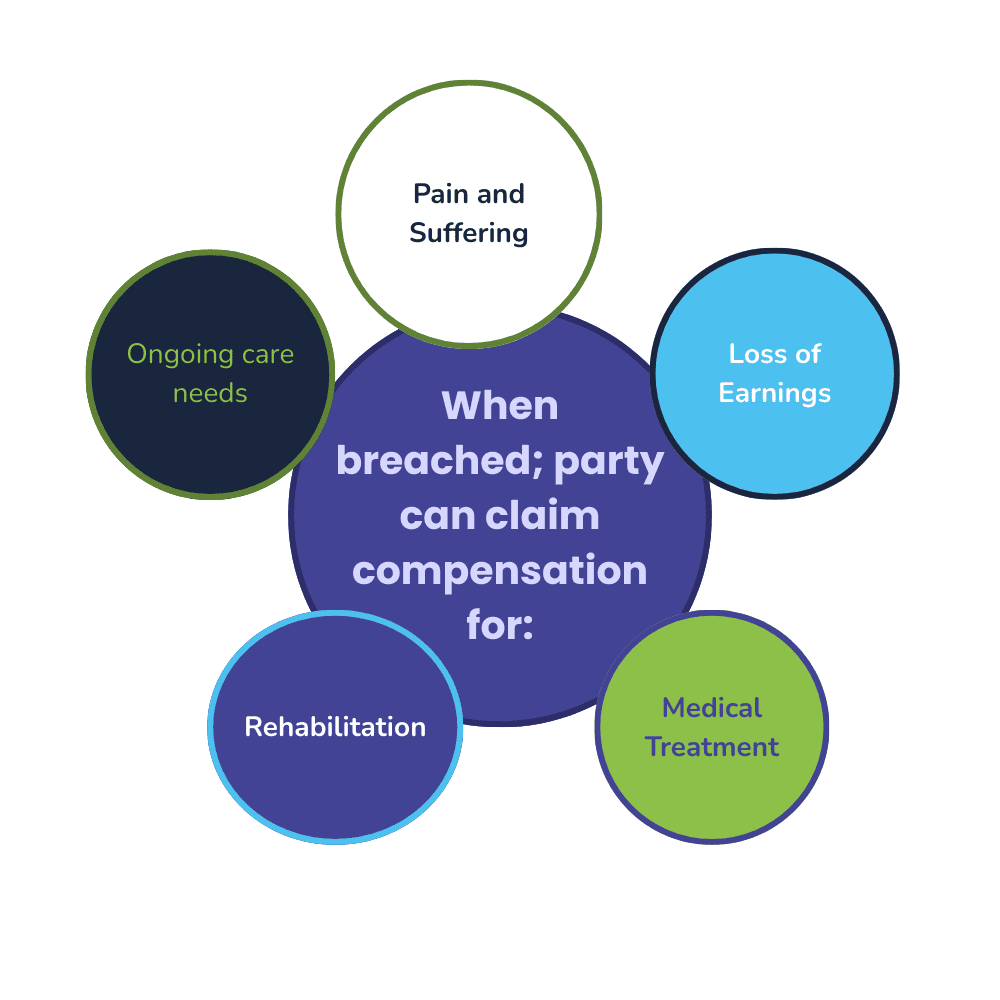
When the duty under the Act is breached and injury results, the injured party may pursue compensation for:
When you are injured on someone else’s property, you need clear advice from solicitors who understand premises liability law and insurer tactics.
At NJS Law, we act exclusively for injured individuals. We understand the physical, financial and emotional impact of unexpected accidents. You can read what clients say about our service on our NJS Law reviews.
When you instruct NJS Law, you can expect:
We handle claims involving:
Every case is handled with care and attention to detail.
If you have suffered an injury on someone else’s property, early advice can make a significant difference.
Contact our Occupier Liability Solicitors today for a confidential discussion about your situation. We will explain:
There is no obligation to proceed – just clear professional advice.
Call us today or complete our online enquiry form to speak with a specialist occupier liability solicitor.
Your recovery matters. Your rights matter.
Let NJS Law help you secure the compensation you deserve.
→ Learn more About Us
Yes.
Homeowners owe a duty of reasonable care to lawful visitors, including friends, family members and delivery drivers.
However, the standard of care is judged in light of what is reasonable for a private homeowner rather than a commercial business.
A lawful visitor is someone who has express or implied permission to be on the premises.
This includes customers, invited guests, tenants and individuals entering during normal business hours.
A trespasser would generally fall under the Occupiers’ Liability Act 1984 instead.
No.
The Act does not impose automatic liability.
A claimant must prove:
Accidents can occur even where reasonable systems were in place.
Not always.
A warning must be sufficient to enable a visitor to be reasonably safe.
If the hazard could reasonably have been removed rather than merely warned about, a sign alone may not be enough.
The adequacy and placement of the warning are also important.
No, but it requires a reasonable inspection system.
The frequency and nature of inspections depend on:
High-traffic retail environments require more frequent checks than low-use private areas.
If a visitor failed to take reasonable care for their own safety, compensation may be reduced under contributory negligence principles.
For example, running in a clearly marked wet area may reduce damages, but it may not eliminate liability entirely.
In most cases, you have three years from the date of the accident (or date of knowledge) to issue court proceedings.
There are exceptions for children and individuals lacking mental capacity.
In most cases, claims are handled through insurance.
Businesses and homeowners carry liability insurance specifically for situations like this. A claim is made against the insurer — not the individual personally.
Professional organisations understand that accidents happen and that insurance exists to protect both parties.
Get in touch using the form below or via the following methods: