
LEGAL GUIDE · ENGLAND & WALES
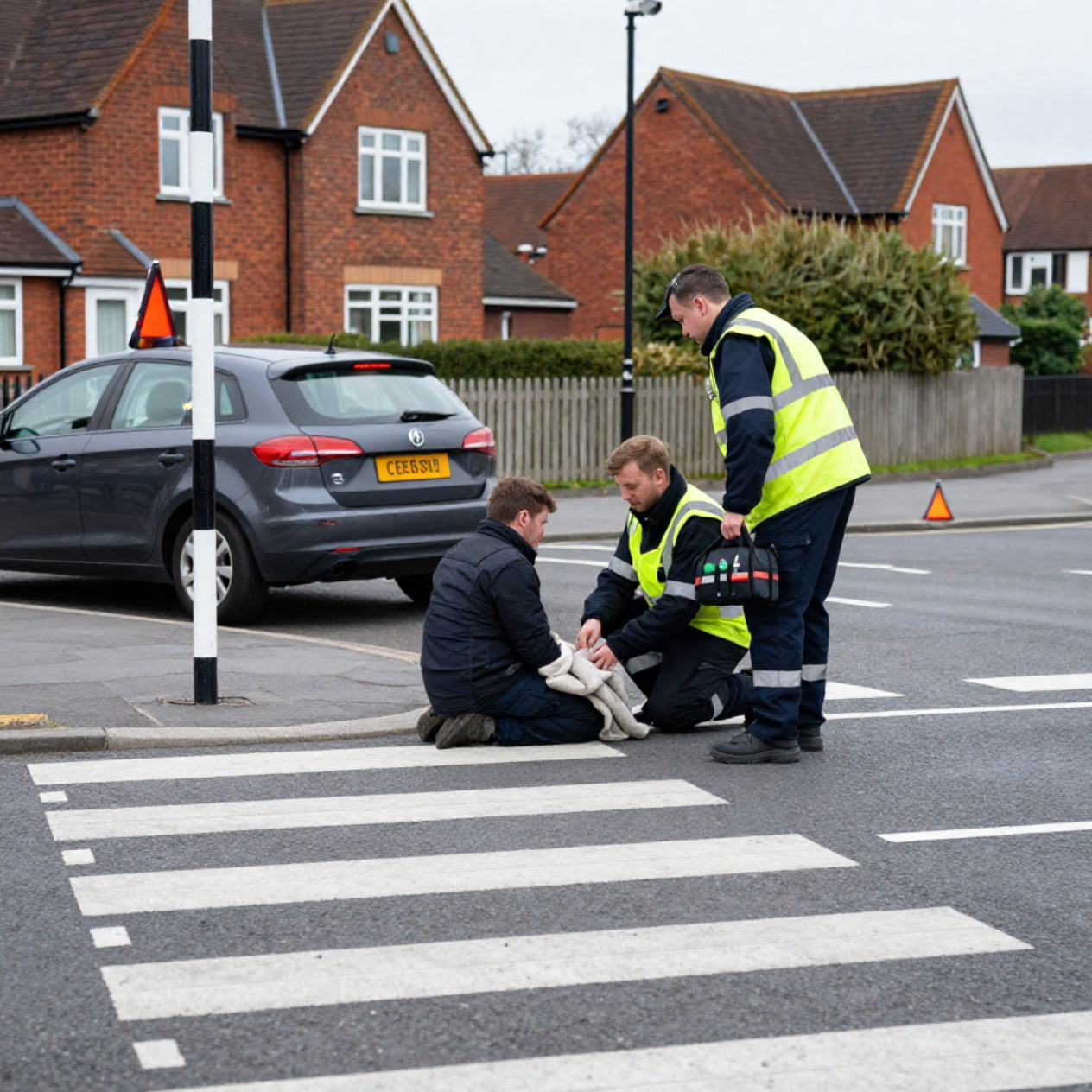
A pedestrian crossing should be the safest place to cross the road. If a driver hit you while you were on one, the law is usually firmly on your side. Here is what drivers must do at each type of crossing, how blame is decided, and how to claim compensation.
IN SHORT
Drivers must give way to anyone who has moved onto a zebra crossing, must stop at a red light on a signal crossing, and must let people finish crossing even after the lights change. If you were hit on a crossing, the driver is usually to blame and you can claim against their insurer. Pedestrians are not covered by the whiplash tariff, so every injury is valued in full. Most claims must start within 3 years.
Hit on a crossing? Find out if you can claim.
Free, no-obligation advice on a No Win No Fee basis.
Call 0800 6525 656 or use the form to check if you can claim.
Speak to NJS Law to understand your options.
Yes. If a driver hit you while you were using a zebra, pelican, puffin or toucan crossing, you can usually claim compensation from their insurer. Crossings exist to give pedestrians a safe place to cross, and the Highway Code places clear duties on drivers approaching them.
A crossing accident can still be disputed. The driver may say you stepped out suddenly, that the lights were green for them, or that you crossed beside the crossing rather than on it. That is why evidence gathered early matters (see below).
If you have been hurt, our pedestrian accident claims team can tell you quickly whether you have a claim.
Each type of crossing works differently, and so do the driver’s duties.
Crossing | How it works | What drivers must do |
Zebra | Black and white stripes with flashing amber beacons. No traffic lights | Drivers must give way once a pedestrian has moved onto the crossing, and should give way to people waiting to cross |
Pelican | Traffic lights operated by a button, with a flashing amber phase for drivers and a flashing green figure for pedestrians | Drivers must stop on red. When the amber light flashes, they must give way to anyone still on the crossing |
Puffin | Signal crossing with sensors that detect people waiting and crossing, and no flashing amber phase | Drivers must obey the lights and should give way to anyone still crossing when the lights turn green |
Toucan | Signal crossing shared by pedestrians and cyclists | As for a puffin crossing: obey the lights and give way to anyone still crossing |
Parallel | A zebra crossing with a separate lane for cyclists alongside | As for a zebra crossing, for both pedestrians and cyclists |
Source: The Highway Code, Rules 195 to 199.
At every crossing, drivers must not park or overtake on the zig-zag lines. They must not overtake the moving vehicle nearest the crossing, or a vehicle that has stopped to let people cross (Rule 191). They should not enter a crossing they cannot clear, and should take extra care when parked or queuing vehicles block their view, because people may be crossing between them (Rules 192 and 193).
GOOD TO KNOW
On every crossing, drivers should give way to anyone still crossing after the lights change to green (Rule 198). A green light does not give a driver the right to drive into someone already on the crossing.
Don’t Miss Out
Thousands of people may be unaware of their rights following a pedestrian accident.
If you’ve been injured, don’t miss the opportunity to find out whether you could claim.
In January 2022, the Highway Code introduced a ‘hierarchy of road users’. Those who can do the greatest harm, such as drivers, have the greatest responsibility to look out for those most at risk, such as pedestrians (Rule H1).
Two changes matter most for pedestrians (Rule H2):
These are ‘should’ rules rather than legal duties, so breaking one is not automatically an offence. But in a compensation claim, the Highway Code is used as evidence of how a careful driver should behave, so a driver who ignored these rules will find it harder to avoid blame. The hierarchy does not remove pedestrians’ own responsibility to take care.
In most crossing accidents, the driver is found to be at fault, because they failed to give way, ignored a red light, drove too fast to stop, or did not keep a proper lookout. Common examples include:
Blame can be shared in some cases, for example if a pedestrian walked out in front of a vehicle that had no realistic chance to stop. Courts recognise that a vehicle can cause far more harm than a pedestrian, so a driver usually carries most of the responsibility even when a pedestrian made a mistake.
Usually, yes. If you were partly at fault, for example by crossing while the red figure showed, starting to cross on a flashing green figure, or crossing on the zig-zag lines next to the crossing, your compensation may be reduced to reflect your share of the blame. This is called contributory negligence. It does not normally stop you claiming altogether.
Children are judged by what is reasonable for a child of their age, so a young child is rarely found to be significantly to blame. Read more in can I claim if the accident was partly my fault?
Crossing accidents are often won or lost on what the evidence shows about the lights and the driver’s approach. If you can, gather or note:
Your solicitor can also ask the council for records showing whether the crossing signals were working and how they were timed. For more on evidence, read what evidence do I need after a car accident?
Understand Your Options
Not sure whether your pedestrian accident qualifies for compensation?
Our personal injury solicitors can assess your circumstances and explain your options.
No Win, No Fee · SRA Regulated · Complete Confidentiality Guaranteed
Pedestrians are not covered by the whiplash tariff or the £5,000 small claims limit for road traffic injuries, so every injury is valued in full under the Judicial College Guidelines (18th edition).
Your claim can include compensation for the injury itself and its effect on your life, plus financial losses such as lost earnings, care, travel, treatment and rehabilitation. For a breakdown, see our pedestrian accident claims guide.
REAL RESULT: £20,000
Our client was crossing at a marked pedestrian crossing when a driver failed to slow down and hit them. They suffered facial, shoulder and arm injuries and anxiety. Using CCTV and witness evidence, our RTA team recovered £20,000. Read the case study.
Most road traffic accident claims must be started within 3 years of the accident. For under-18s, the 3 years starts on their 18th birthday. If someone lacks mental capacity, time does not run while they lack capacity. If the driver did not stop or was uninsured, you may be able to claim through the Motor Insurers’ Bureau, which has its own reporting deadlines.
NJS Law handles pedestrian claims on a No Win No Fee basis. We gather the evidence, deal with the driver’s insurer and make sure every injury and loss is properly valued.
Call 0800 6525 656 or use the form to check if you can claim.
Since 2022, the Highway Code says drivers should give way to people waiting to cross at a zebra crossing. The legal duty to give way starts once you have moved onto the crossing. Either way, always check traffic has stopped before you step out.
Usually the driver. The Highway Code says drivers should give way to anyone still crossing after the signal changes to green, at every type of crossing.
Often, yes. Drivers must still take care around pedestrians near a crossing, and must not overtake on the zig-zag lines. Your compensation may be reduced if crossing beside the crossing contributed to the accident.
Drivers must stop when a school crossing patrol shows a ‘Stop for children’ sign. A driver who fails to stop will almost always be found at fault.
Yes. If the driver cannot be traced or was uninsured, you may be able to claim through the Motor Insurers’ Bureau. Report the accident to the police as soon as possible, as strict deadlines apply.
It is not essential, but it helps. Reporting the accident creates an official record, and the police may have taken statements or collected footage.
This article is for general information only and does not constitute legal advice. No two cases are the same and outcomes cannot be guaranteed. For advice on your specific circumstances, please contact NJS Law directly.
NJS Law is regulated by the Solicitors Regulation Authority (SRA No. 8006550).
Get in touch using the form below or via the following methods: